Based on the work of Professor Jenni Romaniuk (of the Ehrenberg-Bass Institute for Marketing Science), Mental Advantage Analysis evaluates how strongly a brand is associated with specific attributes compared to its competitors in the market. The resulting Advantages and Disadvantages make it easy for brands to prioritize their marketing strategies.
quantilope's Mental Advantage analysis is fully automated, allowing users to easily incorporate this method into their brand tracking studies to generate valuable metrics for brand positioning and communication strategies.
Benefits of leveraging Mental Advantage analysis
Sharpen brand positioning: Understand your brand's unique strengths and areas for improvement to develop differentiated and effective brand positioning.
Refine communication strategies: Identify the key attributes/messages that resonate most strongly with consumers, for more targeted and impactful communication.
Enhance brand equity: Consistently reinforcing your brand's unique strengths and addressing any weaknesses builds a stronger and more differentiated brand image.
How to use Mental Advantage analysis
Mental Advantage analysis highlights how a brand's actual association with an attribute or CEP deviates from the expected association - given the brand’s usage / size and general prototypicality of an attribute or CEP.
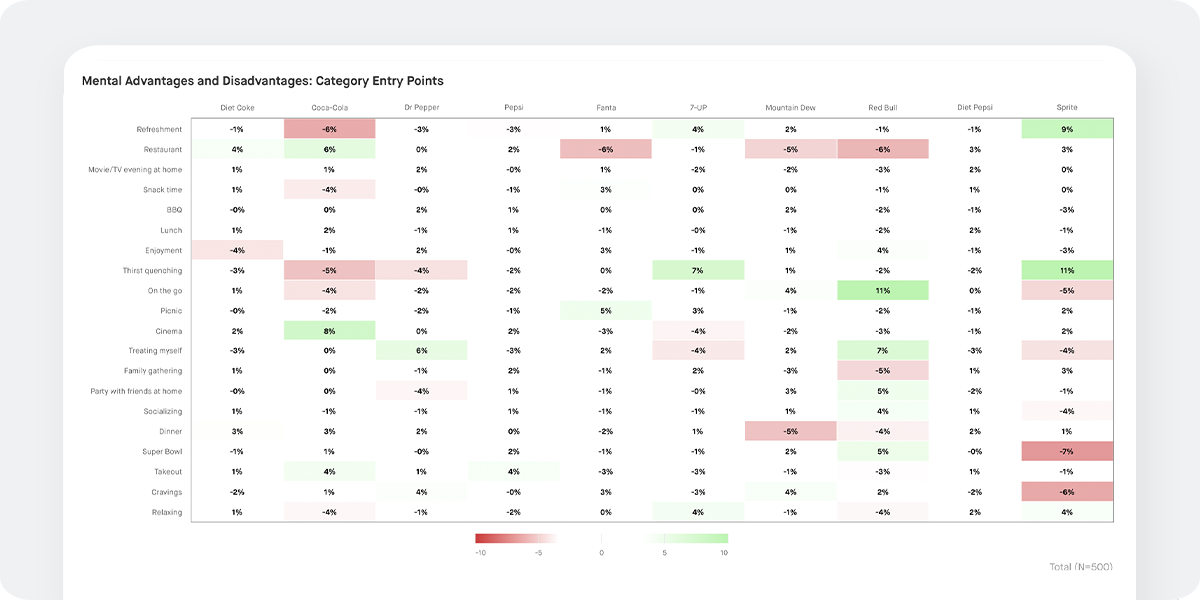
Category Entry Point Advantages and Disadvantages:
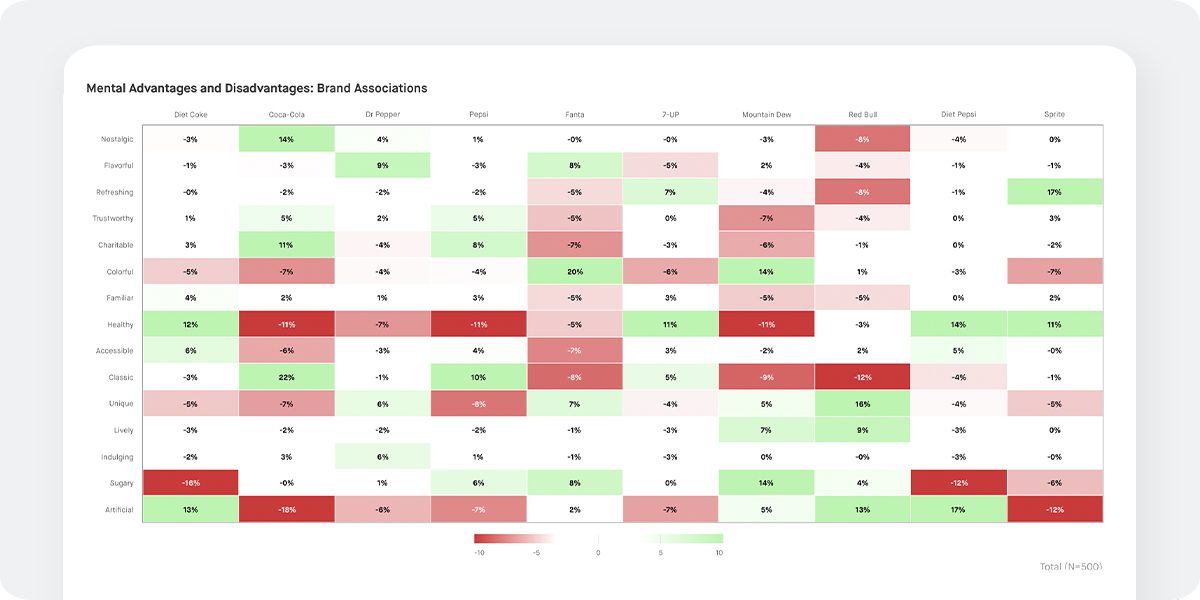
Brand Association Advantages and Disadvantages:
Cells in green are attributes that score 5% or more above the expected score for that brand/attribute relationship (advantages). Cells in red are attributes that score 5% or more below the expected score for that brand/attribute relationship (disadvantages). Cells in white are considered ‘on par’ with expectations
“It’s exciting to see quantilope automate a new, innovative approach to brand health tracking - introducing new metrics from the Ehrenberg-Bass Institute that unlock actionable insights right out of the gate and identify opportunities for brand growth.”
Mental Advantage analysis evaluates how strongly a brand is associated with specific attributes compared to competitors, based on research from Professor Jenni Romaniuk at the Ehrenberg-Bass Institute.
A Mental Advantage occurs when the number of links between a brand and a Category Entry Point is higher than statistically expected, given the brand's size and the attribute's prototypicality. This reveals opportunities where brands can strengthen their market position through targeted communications.
What are Category Entry Points in Mental Advantage analysis?
Category Entry Points (CEPs) are buying scenarios or usage situations that prompt a consumer to shop in a category, measured through Mental Advantage analysis to show which brands come to mind most readily. The analysis highlights which CEPs represent advantages (green cells, 5%+ above expected) or disadvantages (red cells, 5%+ below expected) for each brand.
How does Mental Advantage analysis improve brand positioning?
The analysis identifies a brand's unique strengths and weaknesses by comparing actual versus expected attribute associations, allowing marketers to develop differentiated positioning strategies. Brands can prioritize which attributes to reinforce and which disadvantages to address in their marketing efforts.
How do you act on a Mental Advantage insight?
To act on a Mental Advantage you've noticed in your tracking, you can build those "hooks" into your branding and messaging, and align your physical availability with the specific moments that trigger a consumer to think of you.
For example, imagine you observe a Mental Advantage for your beverage brand: consumers specifically associate your sparkling water with "for a mid-day refresh". With this in mind, you shift your ad creative from generic "all-day refreshment" to visuals of a tired professional closing a laptop and cracking open a cold can. Your tagline becomes: "The 3:00 PM Reset."
To align this Mental Advantage with physical availability, you negotiate with office complex vending machine providers to ensure your product is front-and-center, or you run geo-targeted social media ads with "Get it delivered in 20 minutes" links specifically between 2:00 PM and 4:00 PM.
By leaning into that specific mental hook, you aren't just selling a drink; you’re owning the solution to a predictable moment in the consumer's day.
Your tracking cadence will depend on your specific industry; fast moving consumer goods (FMCG) brands track more frequently while durables or other slower-moving industries track less often.
Regardless of your cadence (monthly, quarterly, bi-annually), consistent tracking allows you to see if you're actually "moving the needle" based on actions you take from Mental Advantage insights (introducing new branding, launching new campaigns, etc.).
What is the difference between Brand Awareness and Mental Advantage?
While brand awareness measures if a consumer knows your name, Mental Advantage measures if they think of you in a specificbuying situation (these situations are known as Category Entry Points). It’s the difference between a consumer saying "I know that coffee brand" versus "I specifically think of that brand when I need an energy boost before a long drive."