


Automated Choice-Based Conjoint Analysis (CBC)
Choice-Based Conjoint (CBC) is a type of conjoint analysis used to measure preferences (e.g. attribute importance), and the willingness to pay for products and services. CBC asks participants to make trade-off decisions between different products in a competitive environment. These trade-off decisions can then be used to find out how purchase likelihood is influenced by various product attributes, such as brand, price, or technical attributes (e.g. a smartphone's battery life).
quantilope's Choice-Based-Conjoint is a fully automated market simulator. Users can add the advanced method to their survey in one click, customize as needed, and engage with results in real-time.
Benefits of quantilope's automated CBC:
Intuitive real-time market simulator mimicking a true shopping experience
Actionable product optimization by identifying specific areas of improvement
Considers a number of attributes for a complete product understanding
Applications of quantilope's automated CBC?
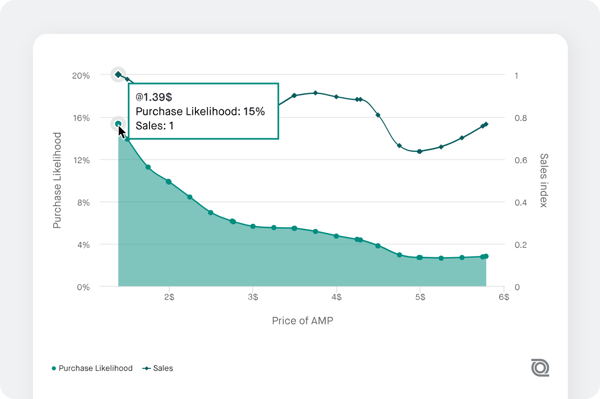
What is the optimal price for a new product?
In this scenario, the optimal price for the energy drink AMP is $1.39, where the purchase probability is highest at 15%
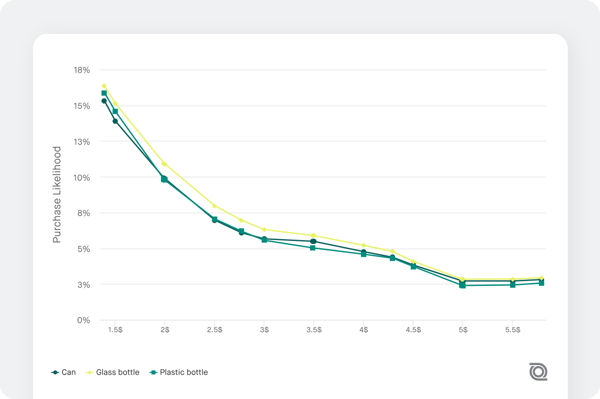
What product features do consumers have the greatest willingness to pay a premium price for?
Between a can, glass bottle, and plastic bottle, consumers are willing to pay more for a glass bottle when purchasing an energy drink.
“Using quantilope’s automated conjoint analysis it became very clear that not all customers think the same. These differentiated results helped decide who to target with which services”
- Hermann Hausenbiegl, Head of Customer Insights & Analytics at Zurich Austria


Additional automated methods
Frequently Asked Questions (FAQs):
When should I use conjoint analysis?
Use conjoint analysis when you need to understand how consumers value different product features and what specific trade-offs they are willing to make during a purchase. It's the gold standard for optimizing new product configurations, setting the right price points, and predicting market share before you launch.
What is Choice-Based Conjoint?
Choice-Based Conjoint (CBC) is the most popular form of conjoint analysis, where respondents are shown a set of hypothetical products with different feature combinations and asked to simply choose the one they would actually buy (or select a "none" option).
By mimicking real-world shopping behavior—forcing people to make realistic trade-offs rather than just rating individual features in a vacuum—it provides highly accurate data for predicting market share, testing price sensitivity, and optimizing product configurations.
How does Choice-Based Conjoint differ from Menu-Based Conjoint
Choice-Based Conjoint differs from Menu-Based Conjoint in that respondents are forced to choose a single, mutually exclusive product configuration from a set of fully formed alternatives, whereas Menu-Based Conjoint allows them to multi-select and build their own custom bundle of individual items from a menu. CBC more closely mirrors a realistic buying scenario where buyers must choose from available products with set features.
What is the difference between MaxDiff and conjoint analysis?
While both measure preferences, MaxDiff (Maximum Difference Scaling) asks respondents to choose the absolute "best" and "worst" options from a list, making it perfect for simple, one-dimensional rankings of features or messages.
Conjoint analysis, on the other hand, packages these features together into realistic product concepts, forcing respondents to make complex, multi-attribute trade-offs (like choosing between a cheaper phone with worse battery life versus a premium phone with great battery life).
What are conjoint "attributes" and "levels"?
These are the building blocks of any conjoint study. An attribute is a general category or characteristic of the product (e.g., Brand, Color, or Price), while a level is the specific option or value within that category (e.g., Apple/Samsung, Blue/Silver, or $799/$999).
How many respondents do I need to run a conjoint study?
While the exact number depends on how complex your product profile is, a standard Choice-Based Conjoint (CBC) study generally requires a minimum of 200 to 300 respondents per customer segment to produce statistically reliable market simulators. If you plan to compare distinct groups (like Gen Z vs. Boomers), you will want that minimum sample size for each group.