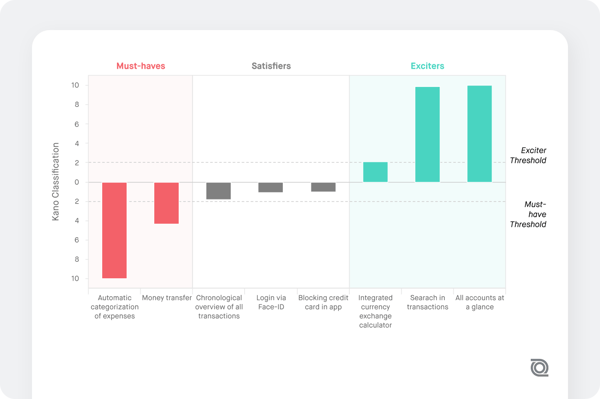
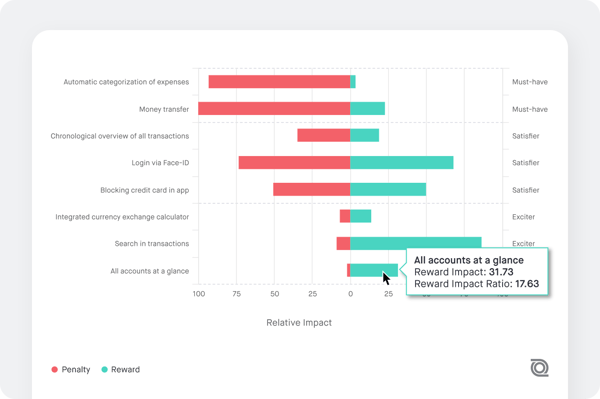
Penalty Reward Analysis (also known as Kano Factors) is used to investigate the type of relationship between an outcome and features used in a Key Driver Analysis. The goal is to understand how an increase or decrease in the performance of a driver will impact the outcome, allowing us to optimize actions for improving the outcome.
quantilope's Penalty Reward Analysis is fully automated, allowing users to drag and drop the method into their survey instantly and watch results in real-time.
Benefits of quantilope's automated Penalty Reward Analysis
Prioritizes features in five distinct categories
Safeguards investments by avoiding unnecessary features or attributes
Encourages innovative thinking by going beyond basic features
Applications of quantilope's Penalty Reward Analysis
What characteristics are ‘must-haves’ for the use of a product?
'Automatic categorization' and 'money transfer' are must-haves for using the Banking App.
Are there features that customers do not expect but that would excite them?
Having an overview of 'all accounts at a glance' excites users, but the lack of this feature is not decisive for the intention to use the app.
“An ongoing challenge for insights professionals is to help executives turn insights into action. Automated methods...are the key to delivering insights that executives not only trust but offer clear recommendations for impact.”
-Chris Wardlaw, Global Research & Insights Director
Penalty Reward Analysis (also known as Kano Factors) is a quantitative research methodology that investigates how various product features will impact customer satisfaction, and allows you to prioritize features for investment.
How does Penalty Reward Analysis categorize features?
Penalty Reward Analysis categorizes features into Must Have Factors (basic features that cause dissatisfaction if missing), Satisfier Factors (linear "more is better" attributes), and Exciter Factors (unexpected delighters).
By measuring the "penalty" of poor performance versus the "reward" of excellence, it identifies which features are requirements and which drive competitive advantage.
What are must-have features in Penalty Reward Analysis?
Must-have features are characteristics that customers expect as standard; their absence significantly reduces satisfaction, but their presence doesn't increase excitement (for example, automatic categorization and money transfer in a banking app).
These features are requirements from customers, so although they aren't rewarded by their presence, there is a big penalty if these basic functions are not met.
What are excitement features in Penalty Reward Analysis?
Excitement features are unexpected "delighters," such as a hotel providing a free room upgrade or a software app including a hidden, highly useful shortcut.
Since customers don't explicitly expect these perks, there is no penalty if they are missing, but their presence creates a significant reward in the form of brand loyalty.
How does Penalty Reward Analysis prevent wasted investment?
Penalty Reward Analysis prevents wasted investment by identifying Must Have Factors, where spending beyond a functional "threshold" yields no additional satisfaction, and Exciter Factors, which allow your product to stand out as more appealing than competitors'.
By quantifying the specific "penalty" or "reward" of each feature, businesses can stop over-engineering "must-haves" and redirect those resources toward "delighters" that actually drive brand loyalty.
How does quantilope automate Penalty Reward Analysis?
quantilope automates the calculation of impact scores to identify the reward and penalty values.
Instead of manual data cleaning or complex coding, quantilope's software automatically calculates the impact of each attribute on overall satisfaction and plots them into a ready-to-use Kano analysis.