The Net Promoter Score (NPS®) is a business KPI that provides insights into general customer satisfaction by directly measuring how likely a company, product, or service is to be recommended.
quantilope's NPS method is fully automated, allowing platform users to drag and drop the method into their survey for real-time NPS scores.
Benefits of automated NPS®:
Simple application with just one NPS rating scale question
Allows for NPS benchmarks through a standardized metric
Serves as a strong indicator of business growth
Applications of quantilope's automated(NPS®) research questions:
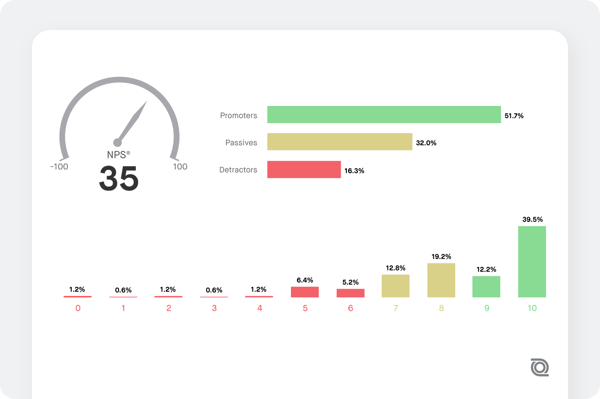
Is my brand’s NPS® positive?
More than 50% of users are already loyal to the brand (promoters), another 19% gave the third-highest value for likelihood to recommend, which indicates the potential for improvement.
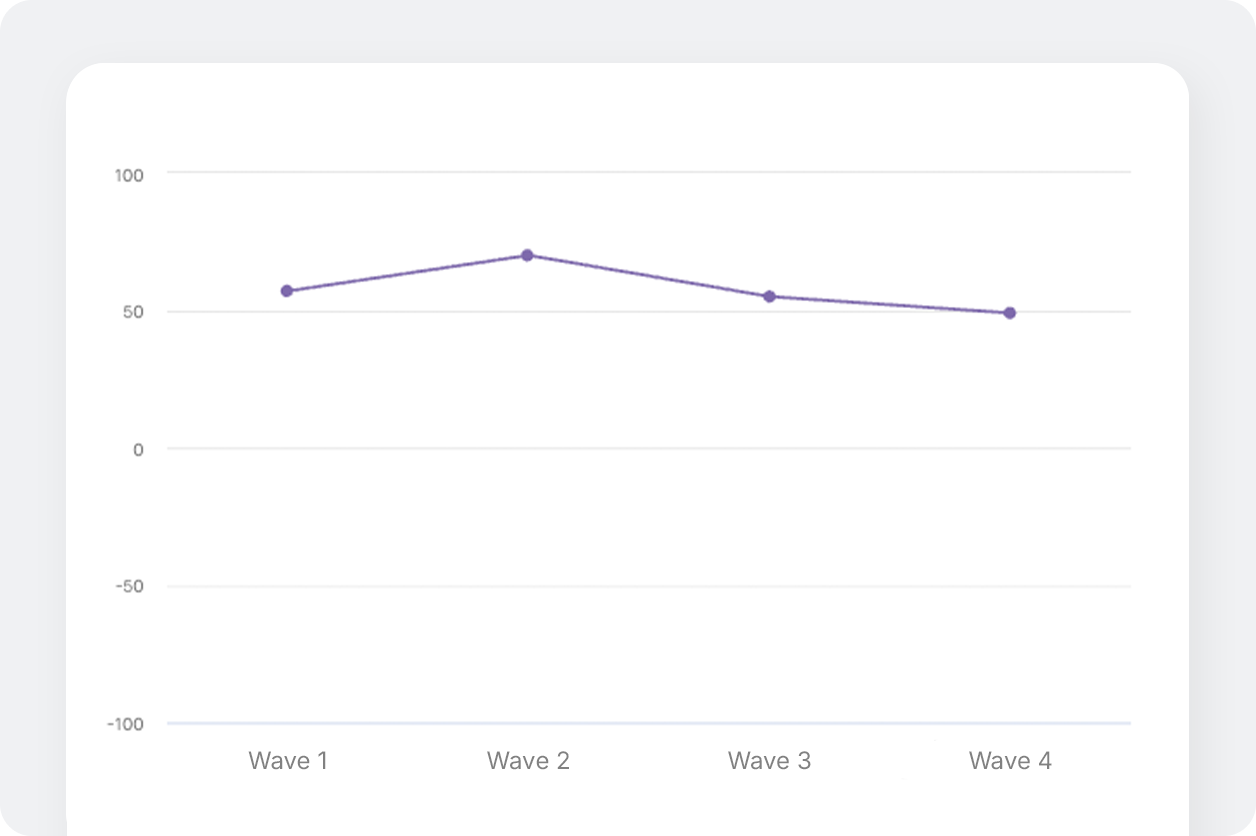
How does my NPS® change over time?
The analysis shows that the likelihood to recommend the brand Lindt was highest in wave 2.
“quantilope has made the process of creating survey questions, finding sample, and reporting findings user friendly and organized. It is truly a one-stop shop for all things involved in market research.”
-Dylan Rose, Senior Manager of Business Intelligence
NPS stands for Net Promoter Score, a business KPI that measures customer loyalty and advocacy by asking how likely customers are to recommend a company, product, or service on a rating scale.
NPS analysis measures customer loyalty on a scale from 0–10, based on how likely customers are to recommend a business to others.
Promoters (Score 9–10): Loyal enthusiasts who fuel growth through positive word of mouth.
Passives (Score 7–8): Neutral customers that neither promote or detract from your brand. When calculating NPS, these customers are included in the overall number of respondents, but not toward the numerator for NPS (%Promoters - % Detractors).
Detractors (Score 0–6): Customers who risk churning or that spread negative word-of-mouth about your brand.
A good NPS is technically any score above 0, but a score between 30 and 50 is widely considered strong, and 70+ is world-class.
How does NPS differ from CSAT and CES?
NPS measures overall customer loyalty and relationship strength, while CSAT measures satisfaction at specific touchpoints and CES measures the effort customers expend during interactions.
Why do some researchers criticize NPS?
Critics argue that NPS reduces complex customer experiences into a single number and lacks scientific validity, though it remains widely used as a standardized benchmarking metric for business growth. When used alongside other key performance metrics, NPS can be a valuable insight into brand perception.
How does quantilope automate NPS?
quantilope's automated NPS is a drag-and-drop method that automatically collects and calculates responses, eliminating manual survey management and enabling real-time tracking of customer loyalty metrics.
How is NPS calculated?
Calculating NPS scores involves subtracting the percentage of Detractors (scores 0–6) from the percentage of Promoters (scores 9–10). Passives (7–8) are excluded from the final calculation.
Why does a "Passive" (score of 7–8) not count toward the final NPS?
Passives are considered "satisfied but unenthusiastic" customers who are vulnerable to competitive offers. They are excluded from the numerator in the NPS formula (% Promoters-% Detractors) to ensure the final score only reflects the net balance of true advocates versus active critics.