

Automated Single Implicit Association Test (SIAT)
Based on neuroscience research, the Single Implicit Association Test (SIAT) is an implicit research method used to uncover subconscious associations towards a category, brand, or product. A SIAT measures which items (e.g. qualities, traits, emotional goals) consumers associate with a single brand, category, or concept.
quantilope's SIAT is fully automated, allowing users to drag and drop the implicit method into their survey instantly and review results in real-time.
Benefits of quantilope's Automated SIAT:
Complements explicit findings with subconscious consumer associations
Reduces social desirability bias by capturing fast, instant consumer responses
Offers versatility for product, brand, or category insights
Applications of quantilope's SIAT
What associations do consumers subconsciously associate with my product category?
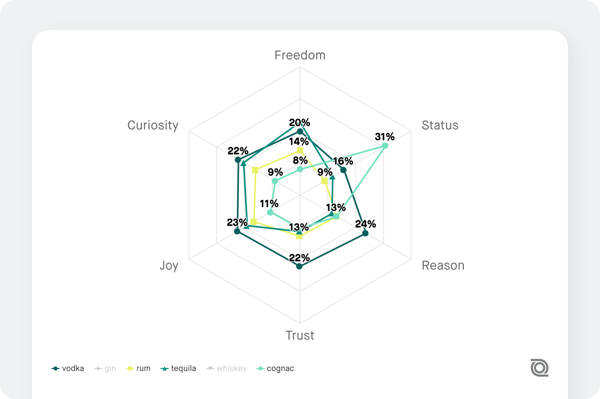
Among the tested alcohol types, cognac is the only category to over-index on 'status' while consumers connect Vodka with 'trust', 'reason', 'curiosity' and 'joy'. Tequila is most highly associated with 'freedom', while rum fails to have strong associations towards any of the category motivations.
Does an advertisement activate the desired association?
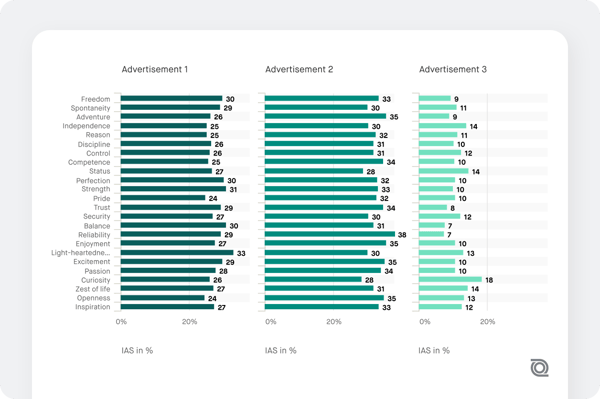
Advertisement 2 activates the highest response to all of the associations with the strongest links to 'reliability', 'enjoyment', 'adventure', and 'excitement'. Advertisement 3 performs the poorest among the group with a low IAS % (Implicit Association Strength in %) across all attributes.
“Leveraging an automated implicit method provides an easy way to tap into your consumers‘ subconscious and uncover what they‘re really thinking - providing new perspectives in a project that you wouldn’t be able to uncover with simple U&A questions alone.”
-Tripp Hughes, Senior Director of Consumer Strategy


Additional automated advanced methods
Frequently Asked Questions (FAQs):
What is the Single Implicit Association Test (SIAT) in market research?
The SIAT is an implicit research method that uncovers subconscious associations consumers have toward a single brand, category, or product by measuring which qualities, traits, or emotional goals they connect with that concept.
Why use SIAT instead of traditional survey questions?
SIAT reduces social desirability bias by capturing fast, instant consumer responses that reveal subconscious associations, providing perspectives that explicit U&A questions alone cannot uncover.
What's the difference between SIAT and MIAT?
The core difference between the Single-Item Attribute Test (SIAT) and the Multi-Item Attribute Test (MIAT) lies in their scope and competitive focus: SIAT measures the implicit association of a single target (like one specific brand) against attributes to provide an absolute, "clean" perception score, whereas MIAT evaluates multiple target categories simultaneously to create a comparative ranking across a competitive landscape.
While SIAT is faster and reduces respondent fatigue by focusing on one item, MIAT is better for identifying which specific brand "owns" an attribute in a head-to-head market analysis, though it requires more complex scoring and longer testing blocks.
Why is reaction time the key variable in these tests?
Both SIAT and MIAT rely on "system 1" processing (gut decision-making). By measuring response speeds in milliseconds, these tests bypass the "social desirability bias" where respondents might consciously lie to appear more ethical or logical, instead capturing their true, subconscious brand preferences.
Can you use SIAT with other advanced methods?
Yes, using SIAT alongside other advanced methods like Penalty Reward Analysis allows you to see not just which features are "Excitement Factors," but whether those features are subconsciously associated with your brand. For example, if "Innovation" is a Reward Factor in your category, a SIAT can confirm if consumers implicitly link your brand to that specific attribute or if your "delighter" is being credited to a competitor.
Similarly, combining SIAT with a Price Sensitivity Meter helps validate whether your "Optimal Price Point" is supported by your brand's implicit value. If the PSM suggests a premium price but a SIAT shows a strong subconscious association with "Budget" or "Value," you may face significant resistance when trying to push your pricing into the "Expensive" range.
Other advanced method pairings include MaxDiff, Conjoint, or even MIAT.
Can SIAT be used to test "Negative" brand attributes?
While most marketers focus on positive traits, SIAT is highly effective at uncovering "hidden" negative associations like "Greedy," "Outdated," or "Unreliable." Because respondents are often reluctant to admit these feelings in a standard survey, the SIAT’s speed-based task is one of the only ways to measure if a brand has a subconscious "reputation problem."
Request an automated SIAT demo