



Automated Multi Implicit Association Test (MIAT)
Based on neuroscience research, the Multi Implicit Association Test (MIAT) is an implicit research method used to uncover subconscious associations toward multiple brands or products. An MIAT measures which brand or product consumers associate most strongly with certain items (e.g. qualities, traits, emotional goals).
quantilope's MIAT is fully automated, allowing users to drag and drop the method into their survey, add customizations, and watch results populate in real-time.
Benefits of quantilope's automated MIAT:
Complements explicit findings with unconscious consumer association
Clearly shows differentiations among competitors
Guides the development of relevant, differentiated marketing campaigns
Applications of quantilope's automated MIAT
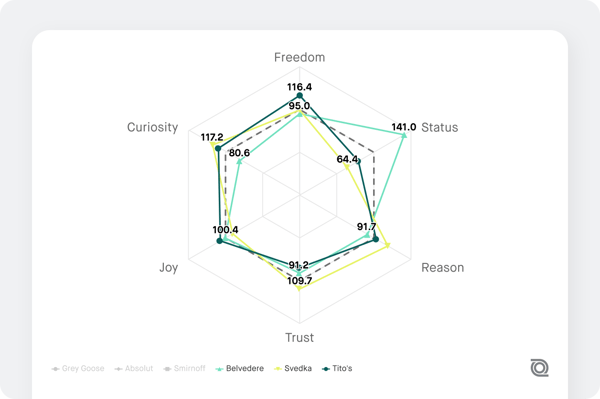
How is my brand positioned against competitive brands in the category?
Among the different vodka brands, Belvedere over indexes on 'status' but falls below the category average on 'curiosity', 'trust', and 'reason'. Tito's out performs both the category average and the other vodka brands in its association to 'freedom' while Svedka has the highest associations to 'trust' and 'reason'.
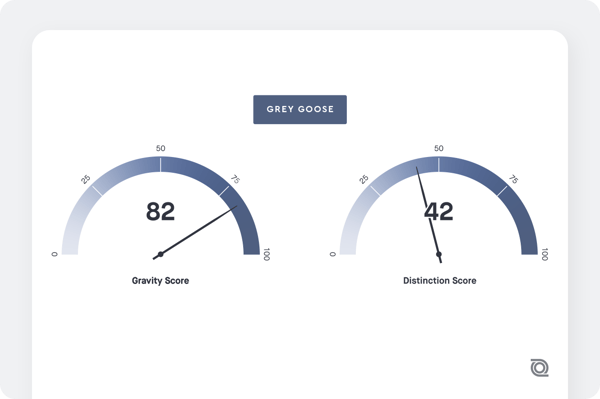
Is the profile of a brand distinct?
Grey Goose attracts many implicit associations however the brand is not very distinct compared to its competitors.
“Leveraging an automated implicit method provides an easy way to tap into your consumers‘ subconscious and uncover what they‘re really thinking - providing new perspectives in a project that you wouldn’t be able to uncover with simple U&A questions alone.”
-Tripp Hughes, Senior Director of Consumer Strategy


Additional automated advanced methods
Frequently Asked Questions (FAQs):
What is the Multi- Implicit Association Test (MIAT)?
quantilope's automated Multi- Implicit Association Test (MIAT) is a type of implicit association test that allows researchers to capture respondents' subconscious associations with multiple brands or products.
A MIAT measures which brand or product consumers associate most strongly with certain items (e.g. qualities, traits, emotional goals).
How is MIAT different from other implicit association tests?
Unlike single implicit association tests (SIATs), which capture subconscious associations for a single brand, product, or category at a time, a MIAT lets researchers evaluate multiple brands and attributes at once.
By scaling the traditional implicit framework, the MIAT provides several strategic benefits:
- Competitive benchmarking: Instead of viewing a brand in a vacuum, researchers can see how a brand performs directly against its top competitors within the same cognitive environment.
- Cognitive efficiency: Because participants categorize multiple stimuli in a single session, the MIAT reduces "test fatigue" and eliminates the need for several separate, repetitive studies.
- Nuanced attribute mapping: It allows for the simultaneous mapping of various brand personalities—such as innovative, trustworthy, or luxurious—across an entire category, revealing "white space".
- Reduced bias: By presenting a broader array of targets, the MIAT minimizes the risk of participants "gaming" the test or focusing too narrowly on one specific brand's imagery.
Can you use MIAT with other advanced methods in a single study?
Yes! When combined with other advanced methodologies, a MIAT generates a more comprehensive picture of how consumers perceive a brand, product, or category landscape.
For example, a research team can combine:
- MIAT + SIAT: Using them in tandem allows you to get a "big picture" view of the competitive category (MIAT) while performing a highly controlled, deep-dive analysis on one specific brand of interest (SIAT) to eliminate any potential contextual bias from competitors.
- MIAT + MaxDiff: While the MIAT reveals subconscious associations, MaxDiff (Maximum Difference Scaling) identifies which specific attributes or features consumers explicitly value most. This helps determine if the "gut feelings" captured by the MIAT actually align with what drives consumer choice.
- MIAT + Conjoint Analysis: Combining these methods allows researchers to see how subconscious brand perceptions (MIAT) influence the trade-offs people make when choosing products with different features and price points (Conjoint).
How does a MIAT reduce the time needed for market research studies?
A MIAT streamlines research by testing multiple brand-attribute pairs in a single automated session rather than running separate surveys for each competitor. This consolidation allows brands to gather comprehensive landscape data in days instead of weeks, significantly lowering the "time-to-insight."
What is the ideal sample size for a Multiple Implicit Association Test?
While sample sizes can vary based on the category, a MIAT typically requires 300 to 500 respondents to ensure statistically significant results across all tested brands. Because the test relies on millisecond-level reaction times, a robust sample helps filter out individual outliers and provides a clear picture of the collective subconscious.
Can a MIAT accurately measure "System 1" consumer thinking?
Yes, the MIAT is specifically designed to capture System 1 thinking—the fast, instinctive, and emotional reactions that drive most buying decisions. By forcing rapid categorizations, the test bypasses the "rationalizing" brain (System 2), revealing the raw, unfiltered associations consumers have with your brand.
Request an automated MIAT demo