

Automated Maximum Difference Scaling (MaxDiff)
Maximum Difference Scaling (MaxDiff) is used to identify consumers' preferences towards product features, advertising claims, or branding. It’s used to understand which items to prioritize by asking respondents to make tradeoffs between the items.
quantilope's MaxDiff is fully automated, allowing users to drag and drop the method into their survey, customize however they need, and watch results in real-time.
Benefits of quantilope's automated MaxDiff
Reduces response bias through forced tradeoff considerations
Engages respondents through a simple gamified approach
Applications of quantilope's automated MaxDiff
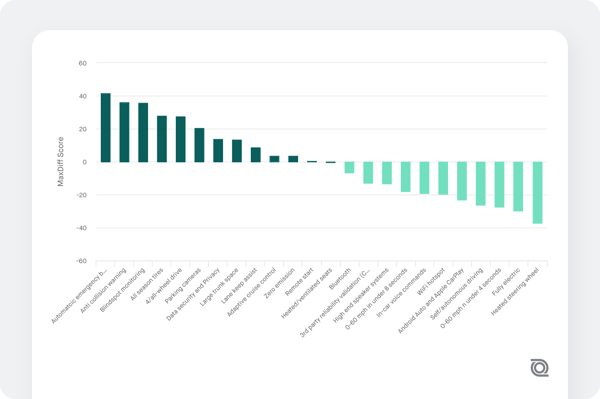
What product features are the most important for the decision to buy?
'Automatic emergency brake,' 'Anti-collision warning,' and 'Blindspot monitoring' are the most important product features when buying a car.
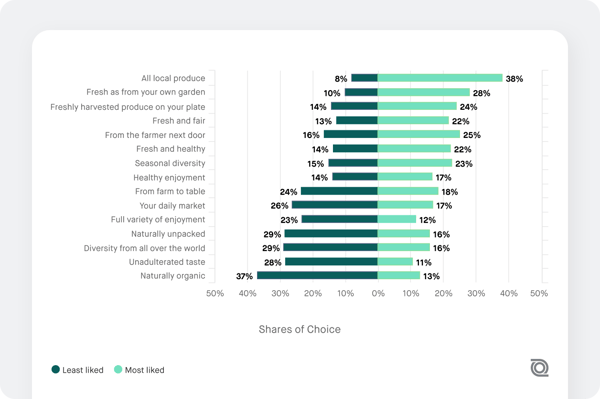
What advertising slogans do consumers find the most appealing?
The most appealing supermarket slogans for consumers are 'all local produce,' and 'fresh as from your own garden'.
“An ongoing challenge for insights professionals is to help executives turn insights into action. Automated methods like quantilope’s Maxdiff are the key to delivering insights that executives not only trust but offer clear recommendations for impact.”
-Chris Wardlaw, Global Research & Insights Director


Additional automated methods
Total Unduplicated Reach and Frequency (TURF)
TURF is used to identify the potential performance of a combination of products, features, or marketing actions. with the greatest performance. TURF analysis will identify which po...
Single Implicit Association Test (SIAT)
Based on neuroscience research, the Single Implicit Association Test (SIAT) is an implicit research method used to uncover subconscious associations towards a category, brand, or product.
Price Sensitivity Meter
(PSM)
Price Sensitivity Meter (also known as Van Westendorp method) is used to investigate different price perceptions and the price limits consumers place in relation to a specific prod...
Frequently Asked Questions (FAQs):
What does MaxDiff stand for?
MaxDiff stands for Maximum Difference Scaling. It is a sophisticated research methodology used to determine the true preference or importance of a list of items (such as product features, brand claims, or ad headlines) by asking respondents to make trade-offs.
How does a MaxDiff work?
MaxDiff identifies consumer preferences by asking respondents to choose the best and worst options from a set of product features, advertising claims, or brand attributes, resulting in a ranked list of priorities — forcing tradeoff decisions rather than allowing respondents to select "all that apply" (often resulting in the "everything is important" fallacy).
What types of business questions can a MaxDiff answer?
MaxDiff can be used for a variety of new product development and marketing efforts, such as uncovering which product features drive purchase decisions and which advertising slogans resonate most with consumers.
Brands can also leverage a MaxDiff to determine which offerings to include in a loyalty program, which features to keep when redesigning an existing product, or which brand imagery is most compelling to include in a future campaign.
By forcing respondents to choose their absolute favorites, you gain a clear, prioritized roadmap for your creative and product strategy.
What is the difference between MaxDiff and Conjoint analysis?
MaxDiff measures each attribute on the same scale for direct comparison, while Conjoint analysis uses an additive model that compares the utility of attributes within a set rather than directly between attributes.
What is the difference between MaxDiff and TURF analysis?
MaxDiff finds the rank order and relative preference of individual items.
TURF (Total Unduplicated Reach & Frequency) finds the optimal mix of items to reach the most unique people.
Think of it this way: If you're an ice cream shop, MaxDiff tells you that Vanilla and Chocolate are the two most popular flavors. However, if you only have space for two tubs, a TURF Analysis might reveal that you should actually carry Vanilla and Mint Chip — because the people who like Chocolate already like Vanilla, but the Mint Chip fans won't buy either.
What's the difference between MaxDiff "HB" and MaxDiff count-based?
The main difference lies in how the data is processed and how much detail you get about individual respondents. While count-based is a simple "tally," HB (Hierarchical Bayes) is a sophisticated statistical "prediction."
Count based MaxDiff analysis measures preferences through simple subtraction: (times chosen Best) - (times chosen Worst).
MaxDiff HB analysis uses advanced regression, with the group's data "informing" individual scores (provides a unique utility score for every individual person.)
Request an automated MaxDiff demo