Deichmann, Europe's leading footwear retailer operating across 36 markets with over 4,700 stores, has maintained a clear, customer-centric philosophy since its founding in 1913: “good, affordable shoes born of passion — it’s that simple.” However, managing a massive portfolio that spans both retail operations and powerhouse sportswear labels like FILA requires a deep understanding of fast-moving market landscapes.
At Quirk’s London 2026, Ina Zhikova (Senior Manager, Market Research & Consumer Insights at Deichmann) and Madita Brandhorst (Associate Director, Tracking Solutions at quantilope) discussed how Deichmann revolutionized its tracking methodology to maintain momentum. Building on its established brand funnel framework, Deichmann leveraged quantilope's AI-driven, automated platform to generate faster, more actionable insights and take a more proactive role in guiding business decisions and supporting brand growth.
Key Takeaways:
- Bridging organizational silos: Category Entry Points (CEPs) and Mental Availability connect metrics across marketing, buying, and leadership into one unified commercial narrative.
- Validating Mental Market Share: quantilope's meta-analysis reveals that Mental Market Share explains roughly 70% of real-world Sales Market Share variance, showing that growing consumer mental associations drives commercial revenue.
- Aligning consumer triggers with inventory: When Mental Advantage data revealed gaps in gym-related buying moments, Deichmann strategically prioritized running/jogging triggers instead to match FILA's existing product inventory and operational capabilities.
Table of Contents:
- From siloed teams to streamlined insights
- Acting on strategic opportunities
- Internal adoption: turning colleagues into "fans and friends" of the data
- Looking ahead: expanding with the "7Ws framework"
- The bottom line
From siloed teams to streamlined insights
Deichmann's insights team partners closely with stakeholders across marketing, buying, sales, and leadership, each bringing distinct priorities and perspectives to brand performance. Marketing closely monitors brand awareness and perception, product and buying teams focus on product perceptions and assortment, and executive leadership prioritizes commercial outcomes such as sales and revenue.
The challenge was not a lack of collaboration, but ensuring these different efforts could be connected into a shared business narrative and translated into actionable insights for decision-making across the organization. The "aha!" moment occurred when the team realized that Mental Availability and Category Entry Points (CEPs)—frameworks pioneered by the Ehrenberg-Bass Institute and Professors Byron Sharp and Jenni Romaniuk—offered the ultimate internal bridge.
To validate the reliability of Mental Availability analysis, quantilope ran its own meta-analysis across more than 100 brands. The analysis revealed that Mental Market Share (MMS) explains roughly 70% of real-world Sales Market Share (SMS) variance. To Deichmann, the commercial implication was clear: to grow sales, they needed to expand when and how consumers are thinking of their brand.
Back to Table of Contents
Acting on strategic opportunities
To capture Mental Availability, a brand must tie itself to CEPs—the situational triggers, thoughts, and environments consumers experience right before making a purchase. Deichmann focused initial CEP efforts around its prominent sportswear label, FILA, mapping out distinct, real-world context points (e.g., “during a walk,” “when running/jogging,” or “at the gym”) then used quantilope’s CEP Generator to expand their list.

Armed with their tracking insights, Ina and team were ready to share their interactive quantilope dashboard. In a room packed with cross-functional stakeholders eager to see the results, it was the Mental Advantage grid that really captured interest.
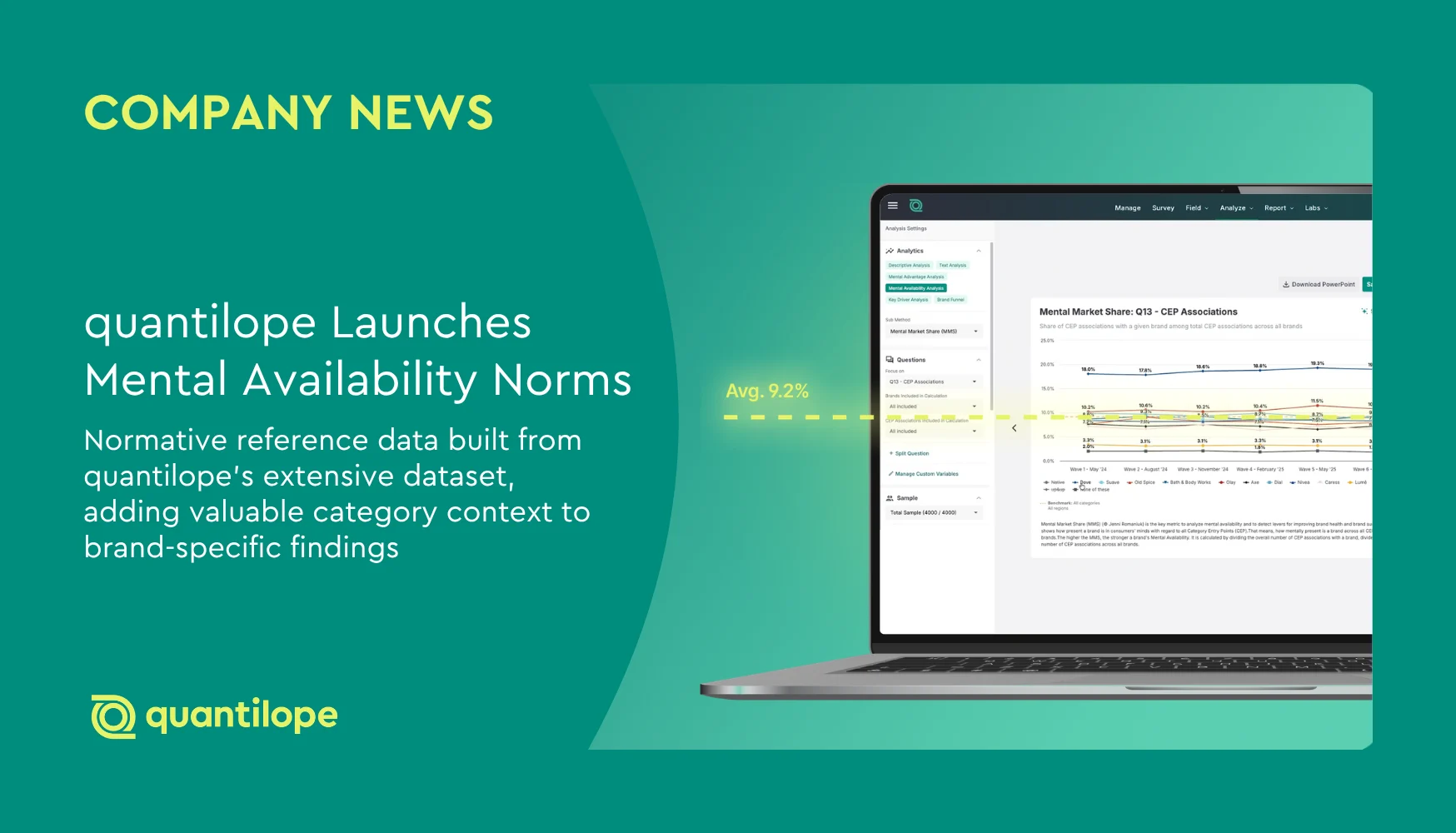
Mental Advantage analysis uses Mental Availability data to map out exactly where a brand overperforms or underperforms across various CEPs. It provides a realistic view of performance by benchmarking results against competitors, brand size, and category norms.
Deichmann’s Mental Advantage analysis delivered some fascinating—and unexpected—realizations for the FILA brand team:
- The tennis heritage opportunity: FILA possesses a rich heritage deeply rooted in tennis. However, the data revealed a hard truth: while consumers aged 45 and older remembered and connected with this tennis history, consumers under the age of 45 did not associate FILA with tennis at all. Instead, a key competitor completely dominated Mental Market Share for tennis triggers. This highlighted an opportunity for FILA to get back to their roots, focusing on the right audiences to build those connections.
- The inventory pivot (gym vs. running): When evaluating open market opportunities, the data showed that competitive sportswear brands had left "at the gym" and "to be athletic" CEPs largely unassigned. While the insights team initially considered targeting this gap, they cross-referenced it with the product and design departments, who noted that FILA’s current inventory didn't align well with gym-specific performance wear.
- Instead, they pivoted their focus to "running/jogging." This trigger was only occupied by a single competitor, and the data identified a clear mental weakness in a secondary rival. Because Deichmann already maintained a strong product line for running and jogging footwear, they had a ready-to-go operational match to capture that specific consumer buying moment.
Internal adoption: turning colleagues into "fans and friends" of the data
Despite initial excitement, transitioning a massive, established organization to a new tracking framework requires careful change management. Deichmann took care to avoid a disruptive company-wide rollout from the start, beginning instead with a step-by-step approach strictly for the FILA brand.
To build momentum, the insights team partnered with quantilope to run collaborative internal workshops. Instead of simply handing over finished reports, they brought the product and marketing teams directly into the platform to co-create and brainstorm the CEPs directly.
"You have to make your colleagues and stakeholders into fans and friends," shared Ina. "When they are active co-creators participating in the process, they take true responsibility for the entry points, and they become highly motivated to use the data in their daily workflows."
This cross-functional alignment directly influenced inventory decisions, media planning, and consumer-facing ad campaigns—ensuring marketing budgets were only spent on opportunities where the brand had the highest probability of commercial success.
Back to Table of Contents
Looking ahead: expanding with the "7Ws framework"
The success of the FILA Mental Availability Tracking pilot has set the blueprint for the broader organization. With over 300 private and partner brands in its wider retail ecosystem, Deichmann is actively exploring how to scale this mindset further.
During the session's Q&A, an audience member raised an important distinction: How does tracking a specific brand (like FILA) differ from tracking a multi-brand retail store (like Deichmann)?
quantilope’s Madita Brandhorst noted that while the core methodology remains identical, tracking a retail brand shifts focus heavily toward "With What" entry points using the 7Ws framework. For a retailer, consumer buying triggers are highly occasion-driven based on product sub-categories—meaning the tracker follows situations such as “where do I go when I need summer sandals,” or “who comes to mind when looking for lifestyle sneakers.”
Back to Table of Contents
The bottom line
By moving away from passive funnel tracking to monitoring Mental Availability insights, Deichmann has transformed market research from a retrospective rearview mirror into a forward-looking commercial engine. Utilizing quantilope's conversational AI and intuitive visualizations, Deichmann is successfully creating a cross-team collaborative hub that will fuel strategic brand growth.
Stay informed on the latest innovations from quantilope by subscribing to the Insights Scoop newsletter below!