At the 2026 IIEX DC conference, Gianna Saladino (Senior Solutions Consulting Manager at quantilope) and Dr. Gary Rozal (Principal Data Scientist at Saatva) discussed how Saatva leveraged quantilope’s Consumer Intelligence Platform to drive growth by building mental associations as the luxury restorative sleep company.
Table of Contents:
Executive Summary
Saatva, a (DTC) brand selling luxury mattresses, has been running a 30-market brand health tracker for over 2 years. While these metrics help inform the brand of awareness, consideration, and usage levels, Saatva still felt it was missing a key part of its brand strategy: what’s bringing consumers to shop for mattresses in the first place, and what brands do they think of when those buying situations arise?
To solve these questions, Saatva added a strategic layer to their tracking approach with quantilope’s Better Brand Health Tracking (BBHT) approach. This framework, inspired by the work of Ehrenberg-Bass Institute Professors Byron Sharp and Jenni Romaniuk, tells brands when, where, and how to play in their respective categories.
It starts with Category Entry Points (CEPs): the wants, needs, and motivations that bring a consumer to shop in a category. Brands that understand and act on its CEPs build Mental Availability: mental “presence” in consumers’ minds so that the brand name is top of mind the moment a CEP hits. By layering quantilope's Mental Availability (BBHT) approach on top of its existing 30-market tracker, Saatva established a strategic blueprint to more effectively compete against industry giants like Tempur-Pedic, Sealy, Serta, Purple, and Sleep Number.
Saatva can now confidently map its brand to real-world consumer buying triggers, validate potential partnerships, and optimize marketing spend based on proven laws of brand growth. Below, we’ll highlight how Saatva did exactly that with a high-profile Team USA partnership for the 2028 Summer Olympic Games: a partnership intended to bridge the gap between consumers knowing Saatva simply as a mattress company and knowing it as a luxury, restorative sleep company.
Back to Table of Contents
A modernized tracker for confident decision making
As a retail brand, it doesn’t matter how many people say they know you. If they’re not thinking of you when it comes time to buy, you’re not converting that awareness into sales.
To make its existing brand pulse check more actionable, Saatva needed a playbook.
The new framework: Mental Availability & Category Entry Points
quantilope’s Better Brand Health Tracking approach is built on the following key concepts:
1. Physical Availability
How easily a consumer can find, buy, and receive a product. For Saatva, physical availability is defined by its online presence, custom manufacturing pipeline, white-glove delivery infrastructure, and 30+ physical Viewing Rooms.
2. Mental Availability
How likely a brand is to come to mind in a buying situation. This happens before a consumer goes to a store or types a query into a search engine. Mental Availability is built entirely on Category Entry Points (CEPs) — the internal needs, motives, and environmental cues that trigger a thought about a product category.
To grow your brand, you need to grow your Mental Availability. For Dr. Gary Rozal at Saatva, this meant acting on CEPs that would build a mental bridge between sleeping well and overall wellness.
Examples of mattress Category Entry Points:
- "Replacing an old, sagging mattress."
- "Moving into a new house or apartment."
- "Seeking to improve poor sleep quality."
- "Wanting to feel comfortable and relaxed."

Key findings & strategic insights
1. A clear path forward
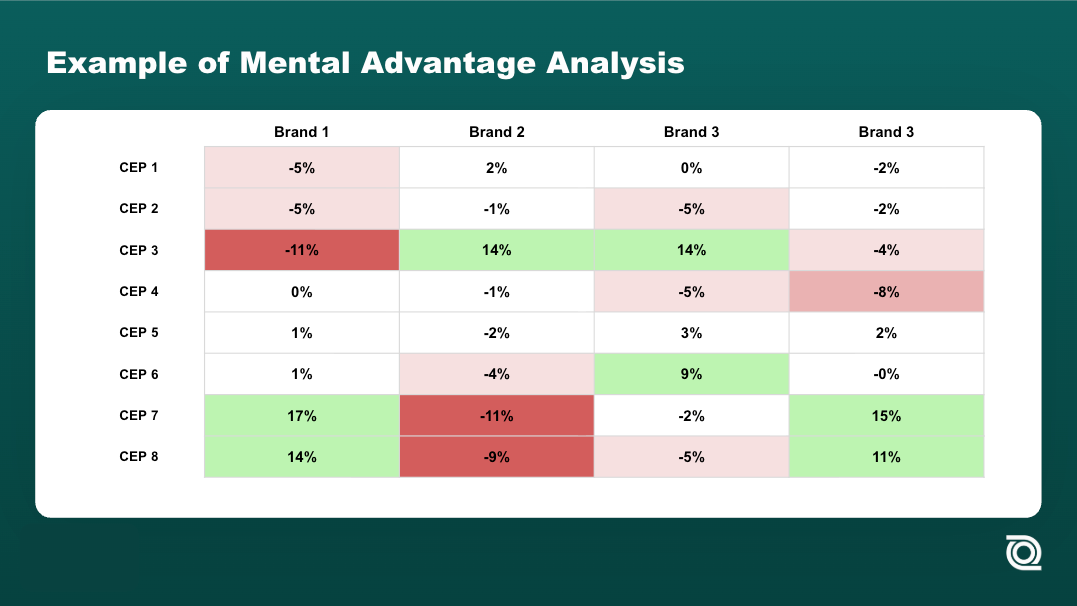
quantilope's automated brand health tracking provides Saatva with a clear competitive matrix for future decision making. Using the framework's Mental Advantage analysis, Saatva can see where it's performing better or worse for Category Entry Points, relative to expectations and to competitors.
- Mental Advantages (Green Zones): Specific buying situations where a brand performs particularly well, taking into account brand size and how typical/obvious a CEP is for the category as a whole. In doing so, the “big players” don’t always win and the “small players” don’t always lose.
- Mental Disadvantages (Red Zones): Specific buying situations where a brand falls short, given its size and CEP commonality. Disadvantages are areas where it would take a significant amount of effort to increase Mental Availability; efforts are often better spent defending Advantages or breaking into whitespace opportunities (CEPs where few or no brands currently have an Advantage — like CEP 5 shown below).
Armed with these insights, Saatva knows precisely where to focus business efforts and investments.
2. Activating the "Team USA" Olympic sponsorship
Backed by its Mental Availability and Mental Advantage insights, Saatva made a major investment to become the Official Mattress and Restorative Sleep Provider for Team USA at the upcoming LA 2028 Olympic and Paralympic Games.
Historically, connecting an athletic event to a mattress purchase is difficult; when consumers see someone sprinting on a track, they don’t typically think about buying a bed. However, using CEP data, Saatva framed the partnership around a universal wellness trigger: “Your day starts and ends with sleep. What happens in the middle is dictated by your rest.”
By shifting the narrative from athletic performance to "restorative sleep" and "wellness," Saatva successfully partnered with the Olympics to target high-value wellness CEPs.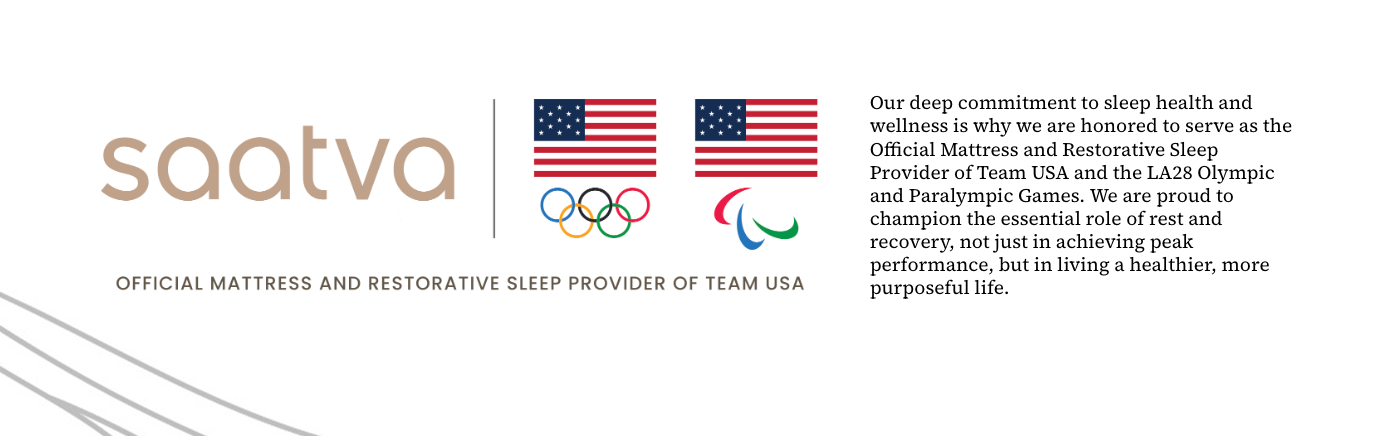
3. Mental Market Share rises
Between the baseline study (Wave 1) and subsequent tracking waves following Saatva's sponsorship activation, the brand observed a measurable increase in its Mental Market Share (one of several key Mental Availability metrics).
Both existing Saatva customers and non-customers began associating the brand with critical CEPs at a significantly higher rate, suggesting marketing activities and strategic partnerships are effectively building mental links, not just brand awareness.
Back to Table of Contents
Business impact & applications
By moving from passive awareness tracking to CEP activation, Saatva transformed its commercial strategy in three distinct ways:
- Optimized marketing spend: Instead of wasting capital on broad, generic awareness campaigns, Saatva shifted its ad spend to target explicit buying triggers, driving highly efficient customer acquisition.
- Data-backed media and influencer selection: The CEP data allowed Saatva to choose specific media channels and health/wellness influencers who naturally align with the exact buying situations Saatva aims to own.
- Scalable activation tactics: CEP data does not require a million-dollar budget. Saatva and other brands can apply these insights immediately by building highly specific consumer wants and needs into strategic decisions, one buying moment at a time.
Back to Table of Contents
Conclusion
Through its partnership with quantilope, Saatva proved that challenger brands can confidently compete with legacy category leaders.
By replacing a stagnant awareness tracker with an agile, scientifically validated Mental Availability blueprint, Saatva successfully connected its brand to the exact moments consumers prepare to buy mattresses — turning marketing investments directly into market share.