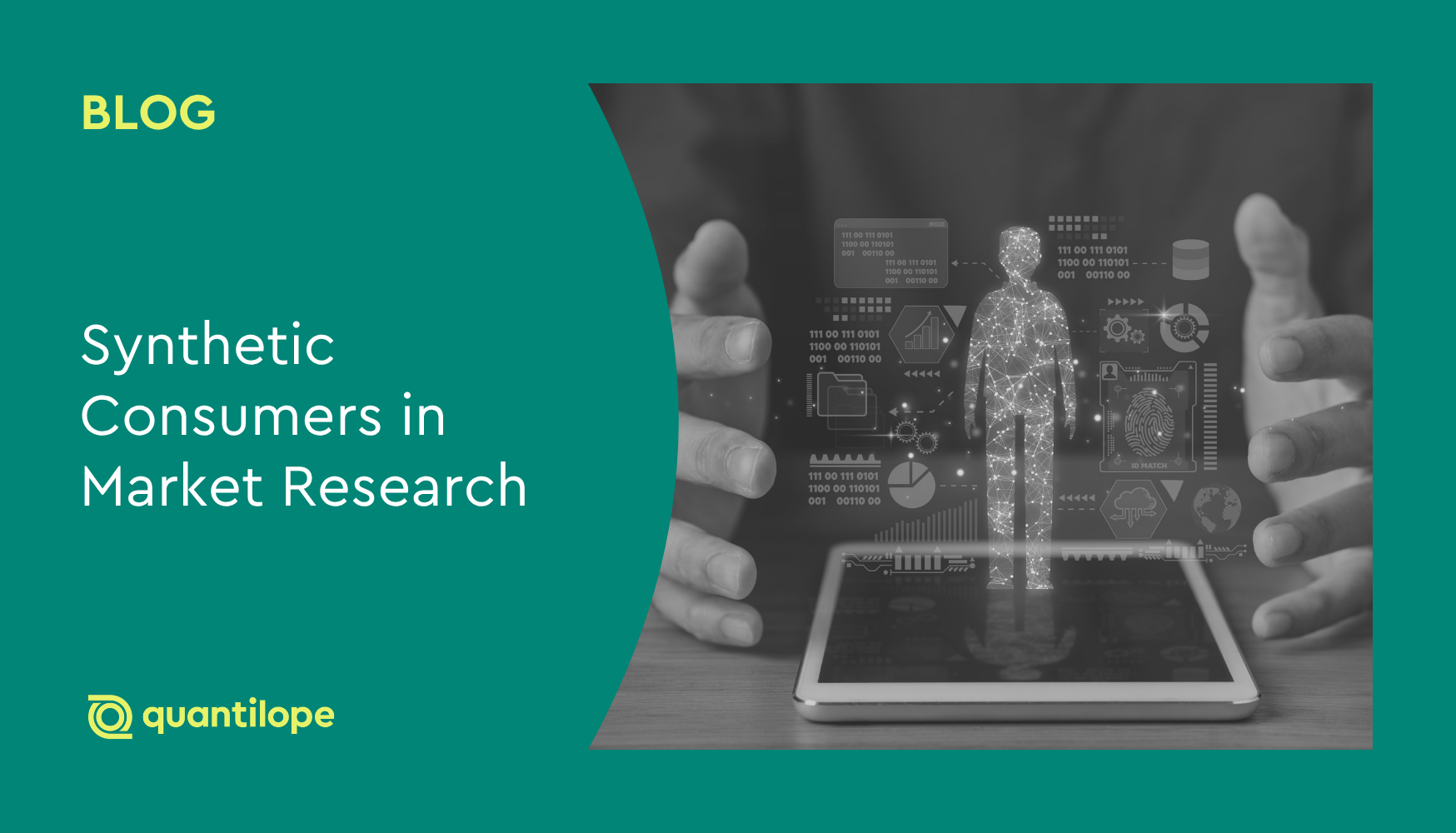
Synthetic consumers are AI-generated representations of real consumer audiences. They are designed to simulate how specific segments might think, react, describe needs, evaluate ideas, or respond to early-stage business questions.In market research, synthetic consumers are not meant to replace real people. Instead, they help insights teams make smarter use of existing data, explore hypotheses faster, and identify which questions deserve deeper validation through traditional market research.
As AI market research evolves, synthetic consumers are becoming part of a broader toolkit that includes ad-hoc surveys, trackers, qualitative interviews, behavioral data, and automated analytics. Used correctly as part of an overall market research approach, they can help brands move from wasted or redundant research efforts to more interactive, always-on consumer intelligence.
For a concrete example, see how quantilope applies synthetic consumer research using digital twins.
Key Takeaways:
- Synthetic consumers are not human replacements: Synthetic consumers are AI-generated profiles based on real consumer data designed to simulate how specific audience segments might think or react. They allow insights teams to converse with existing data, test early hypotheses, and figure out which questions need deeper validation. quantilope applies synthetic research through its innovative Category Twins.
- Quality of input data is critical: A synthetic consumer is only as good as the human data it is trained on. If the foundational data is outdated, biased, or too generic, the AI outputs will lack strategic value, meaning high-quality inputs like survey responses, behavioral patterns, and tracking data are essential for success.
- They are best suited for early-stage exploration: Synthetic consumer research shines during early-stage decision-making, such as exploring new concepts, developing messaging, and pressure-testing internal assumptions.
- The future of market research is hybrid: Synthetic consumers should act as an accelerator rather than a shortcut, and they should never be the sole basis for high-risk decisions like pricing or product launches. The most effective approach is a hybrid one, combining the speed of AI synthetic data with the rigorous validation of real human feedback, advanced analytics, and expert interpretation.
Table of Contents:
- What are synthetic consumers?
- What is synthetic consumer research and how does it work?
- Synthetic consumers vs. traditional personas
- Common use cases for synthetic consumer research
- Limitations to keep in mind
- Best practices for synthetic data in consumer research
- Where synthetic consumers fit among consumer research tools
- How quantilope applies synthetic consumers through Category Twins
- A simple example of synthetic consumer research
- The future of AI market research is hybrid
What are synthetic consumers?
Synthetic consumers are data-informed AI profiles or agents that represent a defined consumer audience. They may be built from sources such as survey responses, brand tracking data, behavioral patterns, demographic information, attitudinal data, or category-specific insights.
Instead of only summarizing what consumers said in a previous study, synthetic consumers allow researchers to ask follow-up questions and generate simulated responses based on the underlying data model, as if they were chatting with human participants.
For example, a brand team might ask a synthetic consumer segment:
- “How would you describe this product idea in your own words?”
- “What concerns would you have about trying this brand?”
- “Which message feels most relevant to your needs?”
- “What would make this concept more believable?”
The value is not that synthetic consumers are “real respondents.” They are not. Their value comes from helping researchers interact with their insights in a more flexible, conversational way.
Back to Table of Contents
What is synthetic consumer research and how does it work?
Synthetic consumer research is the use of AI-generated consumer representations to explore market research questions, test assumptions, or simulate audience reactions. It works by grounding AI outputs in relevant consumer data, then using that data to generate responses from the perspective of a specific target group.
A typical synthetic consumer research workflow includes five steps:
- Define the audience: Researchers start by choosing the consumer group they want to understand. This might be category buyers, brand users, lapsed customers, heavy buyers, Gen Z shoppers, premium purchasers, or another strategic segment.
- Connect the right data: Synthetic models are only as good as their human input data. If the inputs are weak, outdated, biased, or too generic, the outputs may sound persuasive while offering limited strategic value. High-quality inputs include quantitative survey data, tracking results, open-ended responses, demographic information, brand associations, purchase behaviors, or category attitudes.
- Create synthetic profiles or agents: AI then generates consumer-like representations that reflect patterns in the source data. Depending on the solution, these may behave like personas, simulated respondents, or segment-level agents.
- Ask research questions: Teams can “interview” their synthetic consumers, pressure-test early ideas, explore category behaviors, or compare reactions across segments.
- Interpret outputs with research discipline: Treat results as directional insight, not undisputed truth. Like all forms of research, synthetic market research still requires human expertise, validation, and clear boundaries around how outputs will be used for business decisions.
In short, synthetic consumer research turns data into an interactive research asset. It helps teams ask better questions before committing time and budget to larger studies or initiatives.
Back to Table of Contents

Synthetic consumers vs. traditional personas
Traditional personas are usually static descriptions of target customers. They often include a made-up name, demographic profile, motivations, pain points, and buying behaviors. While personas can be useful for brand or campaign alignment, they can quickly become outdated or oversimplified.
Synthetic consumers are more dynamic. They can respond to new prompts, reflect different segments, and support back-and-forth exploration. When built on current data, they can give teams a more flexible way to interact with consumer understanding.
That difference matters. Market conditions change, consumer expectations shift, and brand teams need research tools that can keep pace.
Back to Table of Contents
Common use cases for synthetic consumer research
Synthetic consumer research is especially useful in early-stage decision-making, when teams need quick feedback but may not yet be ready to launch a full research project.
| Use Case | Overview & Objective | Example / Key Applications |
|---|---|---|
| Concept Exploration | Explore how others might perceive an idea before investing in full concept testing. Uncovers confusing language, missing benefits, weak claims, or unexpected emotional associations. | A beverage brand asking synthetic category buyers how they interpret a new functional ingredient or whether a proposed benefit feels credible. |
| Messaging & Creative Development | Compare early taglines, product descriptions, ad scripts, or packaging language. The goal is to identify which ideas have enough consumer relevance to move forward in development. | A marketing team testing messsaging variations to identify which concepts demonstrate enough relevance before advancing to creative production. |
| Category Understanding | Explore category routines, triggers, barriers, and occasions when teams need a faster way to revisit existing tracker or segmentation data—especially when expanding into new categories. | A researcher asks:
|
| Competitive Analysis | Examine how synthetic consumers perceive competitors, what associations different brands own, and where market white space may exist. | An insights leader tests competitive positioning hypotheses before fielding deeper brand equity or investing in further positioning research. |
| Hypothesis Pressure-Testing | Challenge internal assumptions early to uncover friction before investing significant resources into an idea. | A stakeholder asks to validate a "self-evident" product extension to reveal whether consumers actually find it surprising, confusing, unnecessary, or too niche. |
| Follow-up Exploration from Existing Studies | Explore newly surfaced questions directionally at the end of a study without immediately launching another full survey. | An insights team has a conversational deep-dive with its synthetic consumers to understand what may be happening beneath shifts in brand tracking metrics. |
Benefits of synthetic consumers in market research
Synthetic consumers offer several advantages when used responsibly as part of a broader insights system.
Faster learning cycles
Sometimes you need go get directional insights very quickly. Synthetic consumers can help teams explore early questions in minutes, making research more accessible during fast-moving planning cycles.
Better use of existing data
Many organizations already have rich consumer data sitting in trackers, segmentations, and past studies. Synthetic consumers can help teams activate that knowledge instead of letting it remain locked in dashboards or slide decks.
More consumer-centric decisions
When marketers can quickly ask how a target segment might react, they are less likely to rely only on internal opinion or gut feel. This helps shift conversations from “What do we think?” to “What might our consumers think, and what should we validate next?”
Scalable exploration
Synthetic consumers can support multiple teams, markets, categories, or segments. That makes them especially useful for organizations that need consistent consumer understanding across many decisions.
Stronger research planning
Synthetic outputs can help researchers refine survey questions, identify relevant answer options, improve stimulus language, and prioritize the most important hypotheses for validation.
Back to Table of Contents
Limitations to keep in mind
Synthetic consumers are powerful, but they are not a shortcut to true research rigor.
They should never be treated as a perfect prediction of real-world behavior, as they don't truly experience products, shop in stores, feel social pressure, or make decisions under real budget constraints. They also are a direct reflection of the data quality you "feed" them; if you give them poor data, they'll give you poor-quality insights.
Important considerations when leveraging synthetic data:
Synthetic consumers...
- may miss emerging behaviors if source data is outdated
- can produce confident-sounding responses that still require further validation
- may not capture emotional nuance as deeply as qualitative interviews with human consumers
- should not be used for quantifying outcomes but rather for directional insights
- should not be used as the sole basis for high-risk launch, pricing, claims, or investment decisions
Back to Table of Contents
Best practices for synthetic data in consumer research
To get the most value from synthetic consumer research, insights teams need more than AI access. They need a disciplined approach.
Start with a clear business question
Don't use synthetic consumers simply because the technology is available. Start with a decision that needs support. Are you refining a concept? Exploring barriers? Comparing audience segments? Testing a hypothesis? The clearer the question, the more useful the output.
Ground the model in relevant data
Generic AI outputs are not the same as synthetic consumer insight. Synthetic consumers should be grounded in data that reflects the specific category, market, brand, and audience being studied.
Segment thoughtfully
Averages can hide important differences. Consider creating synthetic consumer profiles for strategically meaningful groups such as heavy category buyers, brand users, competitor users, occasional buyers, or high-potential prospects.
Treat outputs as directional
Synthetic consumer responses should inform thinking, not end the debate. Use them to sharpen hypotheses, improve research design, and identify ideas worth validating.
Keep humans in the loop
Researchers should review outputs critically, check for unsupported claims, and interpret findings in business context. AI can accelerate exploration, but human judgment remains essential.
Validate important decisions with real consumers
For major product launches, brand repositioning, pricing decisions, claims testing, or media investment, synthetic research should complement validated research methods rather than replace them.
Document assumptions and data sources
Teams should know what data was used, what audience the synthetic consumers represent, how current the data is, and where the model should not be applied (if anywhere).
Back to Table of Contents
Where synthetic consumers fit among consumer research tools
Synthetic consumers are one part of a modern research ecosystem. They work best alongside established consumer research tools such as:
- Brand health tracking
- Concept testing
- Usage and attitude studies
- Consumer Segmentation
- Advanced methodologies like MaxDiff and Conjoint analysis
- Implicit research
- Qualitative interviews
- Online communities
- Social listening
- Behavioral analytics
The key is knowing which tool to use for which decision. Synthetic consumers are well suited to early exploration, rapid iteration, and hypothesis generation. Traditional quantitative and qualitative methods remain essential for measurement, validation, and high-confidence decision-making.
Back to Table of Contents
How quantilope applies synthetic consumers through Category Twins
quantilope applies synthetic consumer research through Category Twins, an innovation from its quantilabs hub. quantilope's Category Twins are digital twins that help brands interact with their own tracking data in a more conversational way. quantilope describes them as AI replicas of a brand’s target audience that can turn existing tracking data into an interactive, always-on focus group for early-stage questions.
What makes Category Twins distinct is that they are grounded in a customer’s own Better Brand Health Tracking data rather than using generic AI knowledge. The solution uses Mental Availability metrics, Category Entry Points, brand attributes, and demographic inputs to generate responses tied to a brand’s specific category and audience.
Category Twins can also be created for different segments, such as heavy category buyers or brand buyers, allowing teams to compare perspectives across strategically important groups. They update as new waves of tracking research are completed, helping brands keep the synthetic consumer view connected to current market data.
For insights leaders, this creates a practical bridge between ongoing quantitative tracking and fast qualitative-style exploration. A team can use Category Twins to explore a tagline, pressure-test a product idea, understand category associations, compare brand perceptions, or ask follow-up questions that would otherwise rely on a future study.
Back to Table of Contents
A simple example of synthetic consumer research
Imagine a personal care brand is considering a new sensitive-skin product line. Before launching a full concept test, the team wants to understand whether the idea feels relevant, differentiated, and credible.
Using synthetic consumers, the team could ask:
- “Would this product idea fit what you expect from the brand?”
- “What would make you trust this claim?”
- “Which part of the concept feels most appealing?”
- “What would make you hesitate?”
- “How does this compare with competitors you already know?”
The team might learn that the benefit is relevant but the claim feels too clinical, or that heavy category buyers respond differently than occasional buyers. Those early insights can then shape stronger research stimuli and better business decisions.
Back to Table of Contents
The future of AI market research is hybrid
The future of AI market research is not synthetic-only. It is hybrid.
The strongest insights organizations will combine real consumer feedback, behavioral data, advanced analytics, synthetic data, and human expertise. Synthetic consumers will help teams move faster, but research quality will still depend on thoughtful design, reliable data, and disciplined interpretation.
For brands, the opportunity is significant. Synthetic consumers can make research more continuous, more interactive, and more embedded in everyday decision-making. They can help teams explore more possibilities, challenge assumptions earlier, and use existing data more effectively.
But the principle remains the same as with any strong research practice: better inputs lead to better outputs.
When synthetic consumer research is grounded in real data, used for the right questions, and validated where it matters, it becomes a valuable addition to the modern insights toolkit. It gives brands a faster way to listen, learn, and decide — while keeping real consumer understanding at the center of growth.
Frequently Asked Questions: