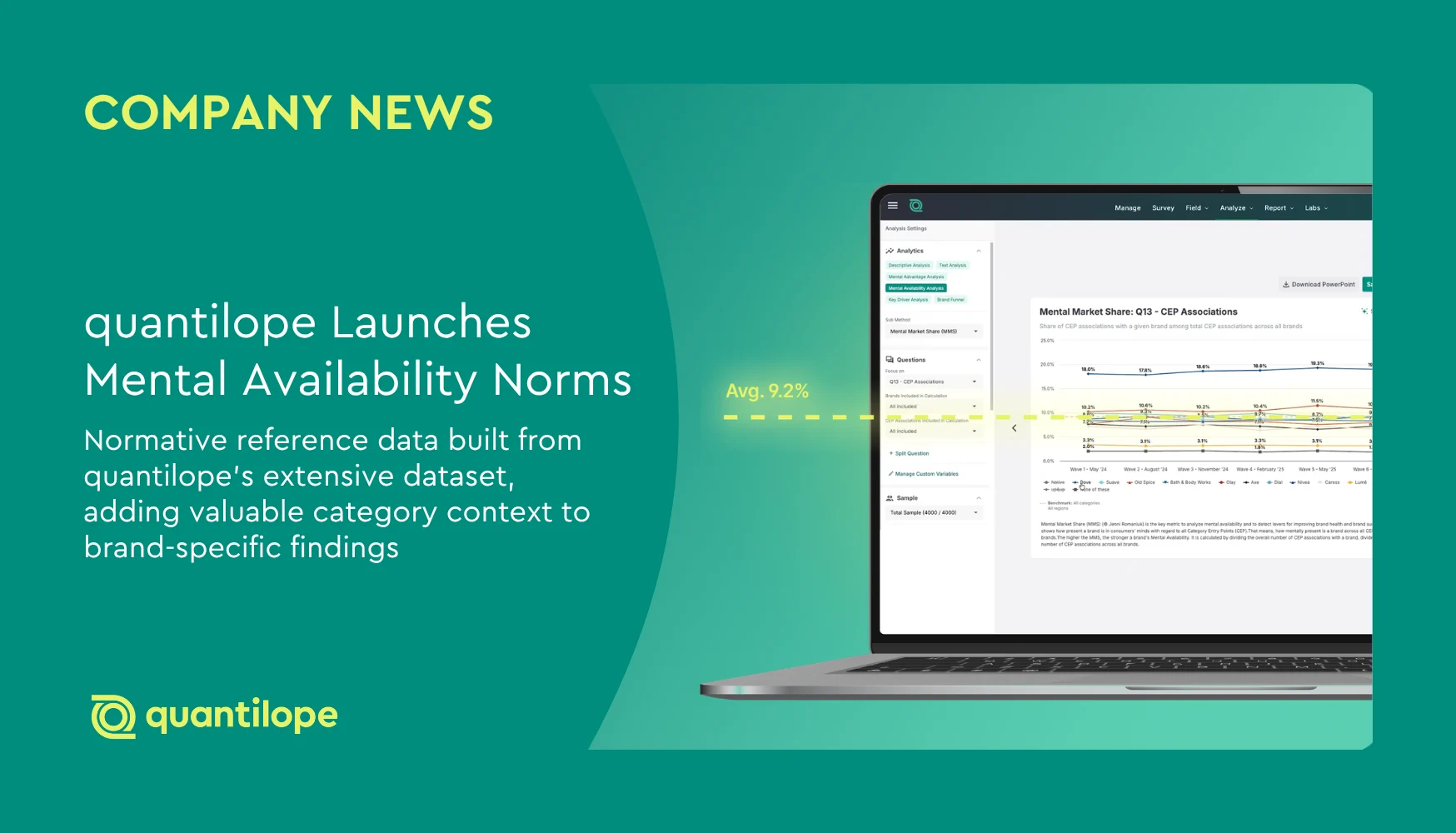
CMOs can reference this blog post as a guide to shifting brand health tracking from 'abstract sentiment' to 'situational dominance' using Category Entry Points.
While traditional awareness trackers tell you if consumers know your brand, they don't tell you if they'll think of it at the moment of purchase. Those moments are Category Entry Points: the real-life cues that prompt consumers to consider a category and choose a brand within it. For Chief Marketing Officers (CMOs), the goal isn't just awareness; it’s being the first brand to mind when a specific need arises. This is how brands grow.
In this blog, we’ll cover the practical workflow (qualitative discovery, quantitative validation, CEP prioritization), how to assess which entry points deserve investment, and how to build CEPs into creative, media, product, and tracking initiatives. For a deeper dive into Category Entry Points and Mental Availability, check out quantilope’s guide to Category Entry Points for more detailed definitions on core metrics like Mental Market Share and Network Size.
Key Takeaways:
- The shift from sentiment to situational dominance: Traditional brand tracking focuses on "awareness" and "brand love," but growth is actually driven by Mental Availability—how likely a consumer is to think of your brand during a specific buying situation or "Category Entry Point" (CEP).
- Identify triggers with the 7W framework: To move beyond generic positioning, CMOs can use the 7W Framework (Why, When, Where, While, With Whom, With What, and hoW-feeling) to uncover real-life cues and emotions that prompt a consumer to enter their brand's category.
- Prioritize via the 3Cs: Evaluate potential entry points based on Commonality (how frequent the moment is), Credibility (how well your brand fits the moment), and Competitiveness (how much "whitespace" exists relative to competitors).
- Bridge the gap with Distinctive Brand Assets: CMOs at high-growth brands don't just aim to "raise awareness"; they use Distinctive Brand Assets (colors, logos, sounds) to anchor their brand to specific CEPs in creative briefs, ensuring the brand is the first solution that comes to mind when a need arises.
Table of Contents
- Understanding CEPs and their importance
- Identifying your brand’s CEPs
- Assessing relevance across different CEPs
- Tools and platforms for CEP research
- Evaluating brand associations with CEPs
- Integrating CEP insights into marketing and brand strategy
- Frequently Asked Questions (FAQs)
Understanding CEPs and their importance
Category Entry Points (CEPs) are concrete, real-life moments or cues — such as needs, locations, companions, or emotions — that nudge a buyer to think about a particular category. Because CEPs anchor brand strategy to buying situations rather than to abstract attributes, they transform generic positioning like “healthy” into specific occasions like “for a quick, nutritious breakfast,” which are easier for buyers to notice and remember.
When brands connect themselves to these moments, they grow their Mental Availability; Mental Availability describes which brands come to consumers’ minds in particular CEP situations. Snickers’ association with “when you’re hungry” and Corona’s “while at the beach” mental connections are prime examples of how surfacing and activating CEPs can create new opportunities for demand and drive incremental reach. These catchy and successful advertising campaigns are memorable because they connect a brand to a specific human want or need. As CMO Alliance best frames it: “...advertising doesn't put people in-market – people put themselves in-market when they experience a relevant buying situation.”
Consider the below comparison between traditional tracking metrics and Mental Availability tracking:
The business case for Mental Availability research:
|
Traditional Tracking |
Mental Availability Tracking (Better Brand Health) |
|
|
Primary Goal |
Monitor brand "love" or sentiment. |
Measure "Mental Market Share" — a metric describing how many different Category Entry Points (CEPs) your brand comes to mind for relative to other brands. |
|
Actionability |
Often results in mandates to "increase awareness". |
Provides specific, actionable creative briefs (e.g., "Win the 3 PM slump"). |
|
Validation |
Often ‘blackbox’ metrics with weak correlation to sales data. |
Scientifically-validated metrics with high correlation to actual sales data. |
We tend to have a lot of metrics when it comes to measuring Physical Availability of our brands but Mental Availability was lacking. I was interested in CEPs because of the potential they could provide us.
- Amanda Cahill, Senior Customer Insights Manager at Coles
Read more about quantilope's case study with Australian supermarket, Coles, here.
Identifying your brand’s CEPs
To maximize ROI, map the situational landscape to identify high-value CEPs within your category. Think about internal triggers (emotions, motives, needs, goals) and external cues (time, place, company, context). Many marketers work with their counterparts from research, sales, and customer experience teams to unlock overlooked situations, or lean on open-ended consumer interviews.
quantilope’s CEP Generator gives you a head start on this process, with a simple form that generates an initial list of 35 CEPs.
Using the 7W framework to discover relevant purchase triggers
quantilope’s CEP Generator leverages the “7W Framework” to identify CEPs, an approach created and introduced by Professor Jenni Romaniuk of the Ehrenberg Bass Institute (EBI) in her book Better Brand Health.
The 7W framework is a simple, yet comprehensive way to uncover key buying situations: Why, When, Where, While, With/For Whom, With What, and hoW-feeling. Using this framework in internal workshops with category experts or external interviews with category buyers will leave you with a comprehensive list of CEPs to use in a future tracking study.
Below is a guide to leveraging Professor Jenni Romaniuk’s way of thinking when developing CEPs:
When leveraging the 7Ws, try to capture full verbatim phrases; buyers’ own words become crucial context when developing messaging and brand strategy later on.
Combining qualitative and quantitative approaches
Another approach to CEP ideation is to blend qualitative and quantitative methods:
- Qualitative methods for breadth: Run cross-functional workshops, consumer interviews, or digital diaries to capture a wide CEP universe and the language consumers use. You may come up with 100 reasons why consumers come to your category, which you can later refine through quantitative research.
-
Quantitative methods for prioritization: Because you can’t feasibly go after dozens of CEPs all at once, you have to prioritize by greatest impact. Online surveys quantify how common each CEP is, measure brand associations, and benchmark competitors.
In short: qualitative discovers, and quantitative prioritizes. Together, they convert a long list of possibilities into a shortlist of actionable, meaningful entry points.
Smiling CFO summarizes it best:
[a quantitative chart] provides a clue as to where brands in this category should focus, but it also confirms that the CEPs originally identified in the Qual. research are the right ones.
Assessing relevance across different CEPs
As a CMO, there’s a good chance other business stakeholders will ask how you chose to prioritize certain CEPs in marketing efforts. Ultimately, you’ll want to choose CEPs that are relevant to business goals. A common way to measure relevancy is to use the “3Cs” — another concept introduced by Jenni Romaniuk in her collaborative whitepaper with the LinkedIn B2B Institute, which focuses on the Commonality, Credibility, and Competitiveness of CEPs. These provide a practical lens to decide which moments to pursue first through a process of elimination.
Commonality
Assess how frequently the entry moment occurs among category buyers and how broadly it spans times, contexts, and segments. Favor moments that show up often and repeatedly in real life. Consider seasonal patterns when assessing commonality.
Credibility
Just because a CEP is popular among your category doesn’t always mean it’ll be the right fit for your brand. Always evaluate how believable and relevant that CEP is for your brand. Consider product capability, experience, pricing, distribution, and distinctive assets. Can your brand naturally show up and solve the need in a way buyers will accept and remember? Strong credibility increases the odds that activation will build durable memory links.
Competitiveness
Gauge how crowded or “open” the CEP is, relative to competitors. Review brand–CEP association data to see which brands are already strongly linked to the CEP and where there are whitespace opportunities. Open or under-served CEPs may yield faster gains; crowded, entrenched ones may require a heavier investment to shift.
Prioritizing CEPs with the 3Cs
Weighing your potential CEPs against the 3Cs adds confidence in your decisions to pursue certain ones (and increases the chances that those decisions will lead to brand growth!). Score each CEP on each dimension, then select a small set to concentrate investment. Remember, resist the urge to “own everything”. Focus builds distinctive memory links faster and more efficiently.
Back to Table of Contents
Tools and platforms for CEP research
Modern research technology makes CEP research and execution accessible and repeatable. You don’t have to be a behavioral scientist or expert in brand health tracking to leverage these tools for your brand growth strategies. Generally, we can summarize CEP tools and platforms into three “buckets”:
- CEP generators to kickstart the brainstorming process
- Social listening tools for qualitative insights
- AI-powered consumer intelligence platforms that automate the end-to-end workflow
In many cases, you may end up using all three types of these tools and platforms throughout your CEP research process.
CEP Generators
Using AI is a great way to kickstart your CEP brainstorming process. AI-driven CEP generation tools help teams rapidly produce a list of potential buying scenarios, turning abstract positioning into concrete buying moments. Used in the early stages of CEP research, these tools standardize inputs, reduce blind spots, and ensure a wide range of buyer motivations and external cues for later quantification. quantilope’s CEP Generator is a prompt-engineered tool that provides a list of 35 initial CEPs in a matter of moments. Brands can use this list as a starting point to further iterate and expand upon for a final tracking study.
Social listening tools
Social listening tools surface organic language people use around needs, contexts, and occasions — in real time. By analyzing public conversations, reviews, and authentic creator content, these tools reveal niche entry points, validate marketing phrasing, and identify seasonal or cultural spikes that can inform CEP prioritization. Check out tools like Brandwatch, Meltwater, or BrandMentions for social listening insights.
Consumer Intelligence Platforms
Consumer Intelligence Platforms are the most comprehensive approach to CEP research. These platforms leverage AI to automate research setup, sampling, data collection, charting, and insight reporting. quantilope’s Consumer Intelligence Platform is one example, streamlining CEP tracking by using AI and automated, advanced methodologies like implicit testing. Platform research relieves researchers and marketers of tedious, manual processes, leaving them to focus on more strategic initiatives (like putting their insights into action!).
Because surveys are the most scalable way to quantify CEPs, automated platforms make it easier for insights and marketing teams to iterate and repeat as often as needed to stay relevant in their category. Many platforms like quantilope tie CEPs to brand health tracking studies so brands can easily maintain a pulse on consumer motivations over time.
Back to Table of Contents
Evaluating brand associations with CEPs
Brand-CEP associations measure the proportion of buyers who link a specific entry moment with your brand. This is the actionable bridge between insights and strategy: it tells you which moments your brand already “owns,” where you’re gaining traction, and for which instances the market is already saturated by competitors.
When you consider these associations across the competitive landscape, you get Mental Advantage analysis.
Mental Advantage analysis
Mental Advantage analysis measures how much better or worse a brand performs, relative to expectations. Those expectations are calculated based on brand size and how ‘typical’ an association or attribute is to the broader category. This allows us to fairly compare brands of different sizes and CEPs with different category commonality. Consider the below examples:
- “Work-from-home lunch”: Brand A is most strongly associated, with Brand B emerging as a challenger, and Brand C showing a smaller but growing presence.
- “On-the-go breakfast”: Brand B is a clear leader; it would take Brands A and C a lot of effort and resources to compete (resources are better spent elsewhere).
- “Entertaining friends”: Brand C is the go-to for many buyers, though Brand B is also frequently considered, and Brand A trails far behind.
Use Brand-CEP association data to guide creative briefs, retail placements, and sponsorships based on whitespace and strategic fit. If Brand B wants to win "Work-from-home lunch," their creative brief shouldn't just focus on "making people aware of our brand," it should clearly connect the brand to the CEP opportunity. For example, they can kick off a 'Work-from-home lunch' ad campaign that starts with a Slack or Zoom ‘alert’ sound to form that mental connection between consumers' workday and Brand B's products.
Distinctive Brand Assets and CEPs
Distinctive Brand Assets (DBAs) are non-brand-name elements (like colors, logos, sounds, and characters) that immediately trigger a brand name in consumers’ minds. DBAs can be key elements to leverage in CEP activation, by pairing priority CEPs with these unmistakable brand cues. While a CEP is the reason a consumer thinks of a category (e.g., "I'm hungry for a snack"), the DBA is the bridge that leads them specifically to your brand.
After identifying top CEPs for your category, leverage your DBAs in marketing or advertising campaigns to connect them to your brand. Ensure distinctive assets (colors, pack shapes, taglines) consistently co-appear with CEP cues across media, retail, and sponsorship touchpoints. For example, you might have a mascot consuming your product on a roadtrip to target the CEP “for a long drive,” or you might use a signature brand sound or "jingle" at the precise moment a character experiences relief in an ad targeting the CEP “for a quick headache fix”.
Aligning DBAs with CEPs keeps briefs, creative, and outreach channels anchored to the specific situations where you have (or are seeking) a Mental Advantage. To measure success of these efforts, we track Mental Availability metrics.
Measuring Mental Availability metrics
Once you’ve decided on CEPs to go after or have paired CEPs with DBAs, you can evaluate the impact of your new campaigns or brand initiatives through measuring and tracking Mental Availability metrics. As the LinkedIn B2B Institute notes, building Mental Availability at scale is a core job of advertising — if your advertising effectively builds brand-relevant memories, your brand becomes more competitive.
There are four main Mental Availability metrics to track over time:
- Mental Market Share is the share of all possible CEPs that buyers associate with your brand; think of it as the key indicator of Mental Availability.
- Mental Penetration is the percentage of category buyers who link your brand to at least one recognized CEP; if you can build Mental Penetration among at least one current non-buyer, your Mental Availability will rise.
- Network Size is the average number of CEPs each category buyer links to your brand — revealing the breadth of your brand’s mental network; the higher your Network Size, the better chances your brand will come to mind in a variety of scenarios (and the higher your Mental Availability will be).
- Share of Mind is a measure of the mental “real estate” your brand occupies in consumers’ minds, relative to competitors. When your Share of Mind goes up or down, you can typically see which competitors you’re taking from or losing to.
One of the best ways to measure Mental Availability metrics is through quantilope’s Better Brand Health Tracking (BBHT) solution. Like pre-study efforts that include the 7Ws and 3Cs, quantilope’s BBHT approach is also based on Professor Jenni Romaniuk’s work at the Ehrenberg-Bass Institute for Marketing Science. Unlike traditional brand health tracking studies which focus on brand funnel metrics (Awareness, Consideration, Usage), BBHT studies focus on what actually brings consumers to the category (CEPs), how they perform within the category (Mental Availability), and how they stack up against competitors (Mental Advantages). When metrics stall or shift, brands know to adjust creative, rotate assets, or rebalance media toward new CEPs.
👉 Learn more about quantilope’s BBHT solution
Integrating CEP insights into your marketing and brand strategy
So the real question as a CMO is how to actually integrate CEP insights into your marketing engine. Above, we covered how CEP insights are incredibly helpful when building out new marketing or advertising campaigns — but CEPs can also drive plenty of other brand initiatives like new product innovations, customer experience/loyalty programs, retailer partnerships, and seasonal promotions.
Because CEPs are a direct reflection of what’s bringing consumers to shop in your category, they should be at the center of everything that goes into your brand decisions, especially considering that if consumers aren’t shopping in your category, they’re not going to be shopping for your brand. When a specific situational trigger occurs — whether it’s a "quick afternoon pick-me-up" or a "last-minute gift for a host" — you want your brand to be the one that instinctively comes to mind.
A CMO’s guide to CEPs:
-
Audit: Use the 7W Framework to identify the "triggers" that actually drive consumers to your category
-
Quantify: Move from "gut feel" to measuring "Mental Market Share" metrics that correlate with sales market share
-
Brief: Use CEPs to give creative teams a specific "moment" to own, rather than a vague brand campaign
-
Track: Replace static awareness scores with a thorough pulse check of Mental Availability metrics, including Network Size and Mental Penetration
By doubling down on the specific entry points where your brand has a right to win, you benefit from more efficient marketing spend that prioritizes high-growth triggers over generic brand awareness. This ensures that every dollar spent is reinforcing a specific, high-intent pathway back to your brand’s products and services.
Leveraging CEP insights across the organization:
|
Department |
The CEP Insight |
The Actionable Output |
|
Creative |
Data shows a high-volume CEP for "Office Stress Relief," but our ads only show "Home Relaxation." |
The Brief: Rewrite the script to feature an office setting. Ensure the "trigger" (a chaotic desk/meeting) is shown before the brand solution. |
|
Media |
Our "Mental Advantage" is highest for the "Morning Rush" CEP, but our spend is currently flat across the day. |
Contextual Placement: Front-load 70% of digital and radio spend between 7:00 AM and 9:30 AM to hit consumers exactly when the trigger occurs. |
|
Product / R&D |
Consumers use the category for "Post-Workout Recovery", but our 2L bottle size is too "inconvenient." |
Innovation: Launch a single-serve, "shaker-friendly" format specifically designed for gym bag portability to win that moment. |
|
Retail / Trade |
A "With-What" analysis shows a 45% mental link between our category and "Hosting a Movie Night" at home. |
Shopper Marketing: Negotiate end-cap displays next to the popcorn aisle. Create "Movie Night Bundle" QR codes for instant discounts. |
For a real-world example of how one brand used CEP insights to shift their marketing and brand strategy, check out this quantilope x Planted case study.
Back to Table of Contents
Frequently Asked Questions