As much as we’d like to think otherwise at quantilope, brands don't run research just for the fun of it. They run research to inform a key business decision: how to grow their brand, which concept to launch, or where the whitespace is.
For years, research was often the slowest part of the process. It created a bottleneck for the rest of the business, often leading teams to cut research altogether. Today, that’s all changing with the influx of AI capabilities in market research.
Below, we’ll walk through the market research process to dissect where AI is speeding up workflows, providing value, and facilitating faster and smarter business decisions.
Key Takeaways:
- Dramatic timeline reduction: AI cuts research timelines by up to 75%, shortening total time-to-decision from over a week to just 1–2 days.
- Automated quality & probing: Integrated AI tools streamline survey programming, perform continuous QA checks, and dynamically probe open-ended answers for deeper qualitative insights.
- Strategic focus for researchers: Real-time automated dashboards and AI-powered cross-project knowledge searches free insights teams from manual reporting, transforming them into strategic advisors.
Table of Contents:
- Traditional market research vs. AI-augmented market research
- Designing impactful surveys with AI
- Leveraging AI for survey programming
- Getting richer answers with AI
- How AI turns raw data into real decisions
- AI as a knowledge management tool
- What AI in market research means for brands
Traditional market research vs. AI-augmented market research
Traditionally, market research was a manual, hand-built process from end to end. At first, surveys were sent out by mail or read aloud over the phone, one respondent at a time, with a researcher tallying the answers on paper before starting any level of analysis.
Online surveys streamlined this process, but still required substantial manual effort; a researcher typed out every question from scratch, sent the survey to a programming team, completed manual quality checks, sent the survey out to respondent panels, and then had to wait for fieldwork to conclude before starting analysis. Only then, could they begin to build a report by hand, add statistical testing, and summarize key findings. With this workflow, every stage had its own queue, and every queue came with its own timeline.
The only way to shorten that timeline was to lean on templated approaches, which could save some time on survey creation and reporting but still often required heavy customization. AI removes these constraints, speeding up the entire research timeline without sacrificing data quality or rigor.
Consider the following journey comparing a traditional workflow to one using AI:
| Stage | Traditional workflow | AI-augmented workflow |
|---|---|---|
| Survey design | Written from scratch: 2 days | Prompt AI with a survey brief, review the output, and make edits: 2 hours |
| QA and review | Manual line-by-line check: 4 hours | AI flags issues automatically before launch; researcher fixes issues: 1 hour |
| Analysis | Custom-built after fieldwork closes: 2 days | Analysis happens in real-time, as respondents complete the survey: 2 hours |
| Reporting | Charts and dashboards built by hand: 4 days | Auto-generated AI dashboards; researcher adds human touch: 4 hours |
| Total time to decision | 7-8 days, plus fielding time | 1-2 days, plus fielding time |
The introduction of AI into the research process has cut timelines by an estimated 75%. AI has the potential to drastically increase the impact that insights teams have on marketing, brand strategy, product development, and more. The point isn't just speed for its own sake. It's that a brand can move from "we have a question" to "we have an answer we trust" in a fraction of the time. This means strategic decisions happen while they still matter.
Back to Table of Contents
Designing impactful surveys with AI
Getting a survey right is not only time-consuming; it requires meticulous attention to detail for high-quality data. Brands have to determine the best methodology, tweak question wording, and ensure consistency throughout the questionnaire. Each of these steps is prone to oversights when done manually, even by the most experienced researchers.
At quantilope, we’ve integrated our AI Research Partner, quinn, into the entire market research process.

Starting with survey design, quinn can draft an entire questionnaire from a simple brief that you can then edit and customize as needed. Rather than a one-size-fits-all template, this approach lets you create a fully custom questionnaire with relevant screening criteria, brand funnel questions, KPIs, usage & attitudinal questions, along with advanced methodologies like MaxDiff, TURF, and Choice-Based Conjoint.
If you’re not sure where to start, simply provide quinn with a general brief or idea and quinn will suggest (and build) the best approach.
Back to Table of Contents
Leveraging AI for survey programming
A poorly worded question or a broken skip logic pattern can compromise your data—and you often don't find out until it's too late! Catching these types of errors before launch is the difference between a quick fix and a complete re-field, saving brands from expensive and time-consuming mistakes.
Once your survey is drafted, AI tools like quinn can automate the actual survey programming:
- Survey logic: quinn can guide you on the exact logic that needs to be set up so that each respondent only sees the questions that apply to them.
- Question optimization: quinn helps select the best question types for your business goals and tighten question wording for clarity and neutrality so you collect cleaner, less biased data.
- Quality assurance checks: quinn checks every question, every route, and every piece of logic in the survey, flagging potential problems before you send the survey to field. quinn acts as a second set of eyes that never gets tired, ensuring an accurate review of every survey.
Back to Table of Contents
Getting richer answers with AI
Even within a survey itself, AI helps to get higher quality responses from consumers.
quantilope’s AI Open End Probing tool automatically generates relevant follow-up questions during a live survey to gather richer responses. Let’s say a survey asks an open-ended question about consumers' first reactions to a new concept. Often, respondents will give vague answers like ‘The packaging looks nice’, which is not very insightful or actionable.
With AI Open End Probing, brands can dive deeper into respondent feedback to learn more, without having to field an entirely new survey. In the example above, this could be a follow-up question like ‘What specifically about the packaging makes it look nice?’ The respondent might then elaborate that they like the shape and size of the package or that it seems like it would be easy to take on the go, already providing the researcher with much more insight.
In the example below from a syndicated study run on RTD Cocktail concepts, AI Open End Probing was able to elevate an open-ended answer from ‘looks good’ to a specific insight: identifying that the flavor was the primary driver of their satisfaction. 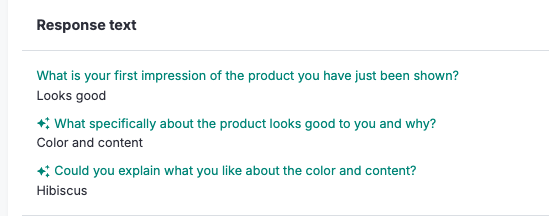
Back to Table of Contents
How AI turns raw data into real decisions
In a traditional market research workflow, the real work starts only after fieldwork is complete. Someone has to clean the data, create the crosstabs, analyze the data, and build every chart by hand before you can start interpreting the results.
AI changes the nature of data analysis. As new responses become available during fieldwork, AI Research Partners like quinn help surface what the data is saying so you can start exploring findings in real time. By chatting with quinn, you can get in-depth analyses in minutes, answering key business questions, diving into specific subgroups of interest, and pulling charts for your stakeholders as they have questions.
quinn can even analyze advanced quantitative methods or build entire dashboards from your data, giving you and your stakeholders a clear view of the numbers without hand-building a single chart. Any charts that quinn builds will automatically update with the latest data as it becomes available (through the end of fieldwork or with any future waves of data in a tracking project).
quantilope also uses AI to power many of our platform analyses including:
- Topic Analysis: quantilope’s Topic Analysis automatically groups open-end responses into meaningful themes, allowing you to easily understand consumers' reactions and thoughts in minutes.
- AI Video Analysis: inColor, quantilope’s qualitative video interviewing tool, uses AI to comb through hours of videos for consistent consumer themes. This includes automated transcripts, sentiment and facial-emotion analysis, and AI-supported ‘showreels’ that automatically pull the best video responses to answer a specific business question.
- Ad Optimizer: With quantilope's Ad Optimizer, brands can quickly analyze their creative assets, either video or static, to see how effectively they communicate Category Entry Points (CEPs) - the mental triggers that link a brand to buying situations.
- Category Twins: A virtual synthetic consumer you can chat with, built on your brand’s tracking data. Your Category Twins can be used to test dozens of ideas quickly before committing to a final direction. This is not a generic chatbot, it’s a custom AI tool built on your specific data.
Back to Table of Contents

AI as a knowledge management tool
AI clearly adds value when developing a survey or analyzing individual data sets, but it can also help with identifying macro-level trends across a larger repertoire of research.
Organizations run countless research projects and often struggle to identify consistencies across them, since most reporting is based on individual project data. With AI, researchers can get more value out of their research portfolio and better identify how previous learnings connect.
In the past, identifying these types of larger themes and learnings was a manual process: you had to flip though hundreds of slides, search across dozens of different folders and share drives, and attempt to manually identify recurring themes. Alternatively, you could upload all of these reports and findings into a generic AI service like ChatGPT, which is better, but still isn’t specifically designed for the nuances of analyzing consumer data.
quinn Search solves this problem. quinn is able to instantly search across all of the projects that an organization has ever run. Simply ask quinn about all the research you’ve completed in quantilope’s platform, and within minutes, quinn will sift through all of your projects to identify key themes and learnings. Ask quinn which advanced methods you’ve run in the past, what you already know about a particular audience, or what topics you already have data on. This could be the difference between running an entirely new study and having an answer in moments from data you already own.
Back to Table of Contents
What AI in market research means for brands
Overall, the benefit of using AI for market research is clear: a well-built survey in a fraction of the time, higher quality data, fewer mistakes, and faster time to insights.
AI will never replace a researcher's human judgment about what to ask and what consumers mean. However, it can remove the manual pains around survey programming, quality checking, and chart-building that used to stretch a study across weeks.
With quinn threaded throughout the entire research process, brands get to decisions faster and with more confidence. Insights teams can shift from research execution to being strategic partners that advise the business on what to do next. With quinn, research can happen at the speed that your business actually moves, shifting insights from a support function to a driver of brand growth.