Choosing a global brand tracking platform is one of the most significant investments an insights team will make. The right partner helps brands transform their tracking from passive reporting into a proactive growth engine.
This guide explores how to navigate the complex landscape of modern insights technology and why a platform-based, AI-driven approach is the new gold standard for global brands.
Key Findings
- Moving beyond vanity metrics: Traditional funnel metrics like brand awareness are no longer enough to stay relevant and competitive in today's global markets; top brands now prioritize Mental Availability and Category Entry Points (CEPs) to achieve effective brand growth.
- Automation is non-negotiable: High-growth brands are using automated research platforms to speed up decision-making.
- AI as a Research Partner: AI is shifting from a "nice-to-have" feature to an essential end-to-end partner that drafts, programs, validates, and analyzes global studies in real-time.
- The power of one: Centralizing global data into a single, end-to-end platform eliminates version control issues and ensures a single source of truth across markets.
- Modernizing your tracker: Transitioning from a traditional tracking system to a modernized platform solution is possible with the right partner. Platforms like quantilope have tools in place to easily adapt a questionnaire and continue tracking in a more tech-forward fashion.
Table of Contents
- Understanding global brand tracking platforms
- Emerging trends in brand tracking technology
- Core criteria for selecting a platform
- Ensuring global scalability and integrations
- Evaluating the right data mix for KPIs
- Assessing tracking cadence and timeliness
- Recap: Building a robust global tracking program
- Frequently Asked Questions (FAQs)
Understanding global brand tracking platforms
In a global marketplace, staying ahead of consumer sentiment isn't just an advantage — it’s a necessity. To effectively grow a global brand today, you need a forward-looking strategy that captures not just who knows your brand, but how deeply it’s embedded in consumers’ minds across different regions and cultures.
A global brand tracking platform is a software designed to measure brand health across multiple geographic markets over time. Unlike ad-hoc studies, these platforms provide a continuous stream of data, allowing insights teams to monitor how marketing campaigns, economic shifts, and competitive moves impact their brand perception and performance.
The most advanced platforms today have moved away from the "service-heavy" model of the past. Instead of waiting weeks for a manual report from a traditional agency, modern platforms offer a self-service environment where automation handles the tedious processes and heavy lifting, leaving researchers free to focus on strategic storytelling and business impact. At quantilope, we call this "DIQ" — or, do-it-with-quinn (our integrated AI Research Partner).
Back to Table of Contents
Emerging trends in brand tracking technology
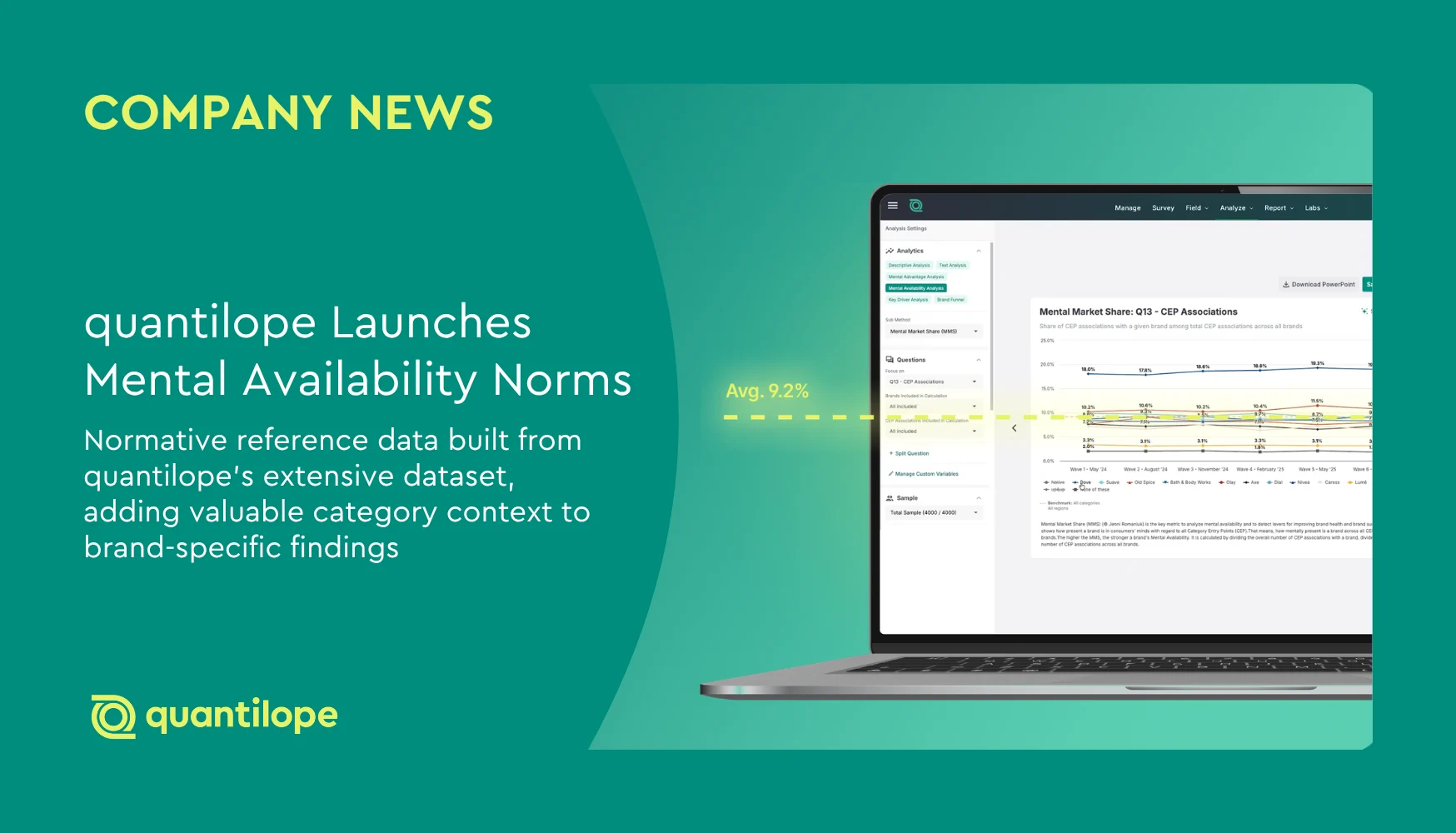
The biggest shift in the industry is the move toward "Better Brand Health Tracking." Developed by Professor Jenni Romaniuk at the Ehrenberg-Bass Institute, this approach expands on Byron Sharp’s How Brands Grow principles. It prioritizes the measurement of Mental Availability — specifically, the likelihood that a brand will come to mind during a specific buying situation or usage occasion. Brand tracking technology is now catching up to this science, allowing brands to measure complex consumer associations at scale.
We’re also seeing a massive surge in AI integration across tracking platforms. It’s no longer just about "chatbots." Advanced platforms now use AI as a central "nervous system" to convert high-level business objectives into structured global studies — in minutes. This ensures that even the most complex multi-market trackers are launched with methodological rigor and without manual errors.
Back to Table of Contents
Core criteria for selecting a brand tracking platform
When evaluating potential tracking platforms and partners, look for ones that offer speed, rigor, and customizable solutions. You’ll want a platform that doesn't force you into a "one-size-fits-all" template but instead offers the right advanced tools for your unique business needs.
|
Criterion |
What to Look For |
Why it Matters |
|
Automation |
End-to-end automation from initial study design to final reporting. |
Reduces human-error and significantly cuts turnaround times (often by a matter of weeks). |
|
Methodological Depth |
Access to a wide array of advanced methods like MaxDiff and Implicit Association Testing. |
Uncovers the "why" behind consumer behavior, not just the "what." |
|
Sampling Agnostic |
Ability to connect to any global panel or your own database. |
Ensures you can reach your specific target audience in any market. |
|
Real-Time Dashboards |
Live data updates as fieldwork progresses. |
Allows for immediate course correction and faster stakeholder sharing. |
Ensuring global scalability and integrations
Global tracking requires a delicate balance between consistency and local relevance. Look for a solution that centralizes all projects in one hub, ensuring that your data isn't fragmented across different vendors or local agencies. You’ll want a platform that can quickly adjust for regional factors such as localized Category Entry Points, currencies, languages, or sampling requirements. This ensures that a marketing lead in New York and a brand manager in Tokyo are both looking at the data that matters most to their specific growth targets.
As your brand scales, don’t risk getting stuck in data silos. Make sure your chosen tracking platform can seamlessly integrate with other business intelligence tools and CRM systems. This allows you to correlate brand health metrics directly with sales performance, providing the holistic visibility needed to drive growth.
Back to Table of Contents
Evaluating the right data mix for KPIs across platforms
Many tracking platforms focus on traditional brand funnel metrics like awareness, usage, consideration, and loyalty. However, the most innovative brands are now shifting their KPIs toward metrics that correlate more closely with future sales, such as Mental Market Share.
|
KPI |
Key Metrics to Include |
Business Impact |
|
Mental Availability |
Mental Market Share, Mental Penetration, Network Size, Share of Mind. |
Predicts long-term growth, discovers actionable opportunities, and identifies barriers to category entry. |
|
Brand Recognition |
Goes beyond funnel awareness to determine if your brand assets are actually effective in the market. |
|
|
Brand Sentiment |
Net Promoter Score (NPS), Trust scores, Brand Affinity, Qualitative sentiment scores |
Validates the quality of mental links; ensures that being "thought of" also leads to a selection. You can have high brand awareness, but if it’s due to bad PR or negative brand reputation, that’s not going to convert to a sale. |
Assessing tracking cadence and timeliness
If you’re in fast moving consumer goods (FMCG), consumer preferences and promotional cycles can shift overnight making quarterly (or even monthly) tracking essential to catch shifts before it’s too late to act. For durables or high-consideration purchases like appliances, cars, or insurance services, once or twice a year is often sufficient enough to capture long-term brand shifts. Whether you choose a continuous "always-on" approach or less frequent waves, your platform should be able to handle the transition between waves seamlessly.
Automation is the key factor here. On an advanced platform, launching a new wave should take just a few clicks, not a few weeks. This is where platforms hold a unique advantage over traditional agency trackers where teams are left managing color-coded documents and outdated versions of a study. Automation allows your team to spend more time analyzing the significant changes in your data rather than worrying about the tedious mechanics of fielding your next wave.
Back to Table of Contents
Recap: Building a robust global tracking program
Building a global tracking program is no longer the multi-month, manual undertaking it once was. By leveraging AI and automation, brands can now move at the speed of their consumers without sacrificing the methodological rigor that global stakeholders demand. Whether you're building from the ground up or migrating from a legacy provider, the goal is the same: transform brand tracking from a retrospective report into a proactive growth engine.
Tracking strategies for global success
- Prioritize lean, high-impact studies: It’s tempting to ask every question that comes to mind when building a global study, but "survey fatigue" can severely impact your data quality, leaving you with lots of insights but no reliable actions. Focus on the core KPIs that actually drive growth — like Category Entry Points and Mental Availability. Use your platform’s flexibility to deploy modular "deep-dives" for local campaigns or product launches as needed, keeping your core tracker agile and your data quality high.
- Empower your team with AI Research Partners: Leverage AI tools like quantilope’s quinn to quickly build global studies and analyze thousands of responses. AI Research Partners don’t replace your expertise, they allow you to focus on the strategic storytelling side of tracking, rather than tedious, manual processes.
- Vet your user experience: A platform is only as valuable as the people who can use it. During a demo, focus on the ease of the actual workflow. Is the interface intuitive enough for a regional brand manager to pull their own insights, or is it a "black box" that requires a PhD in statistics to navigate? The most successful global programs are those where data is accessible, visual, and ready to be shared at a moment's notice.
Ultimately, a modernized global tracker is more than just a brand measurement tool — it’s a competitive engine. By bridging the gap between sophisticated AI and human strategy, you move beyond simply 'monitoring' your brand to actively steering its growth in every market you serve.
To learn more about global brand tracking with quantilope, get in touch below!
Frequently Asked Questions (FAQs)